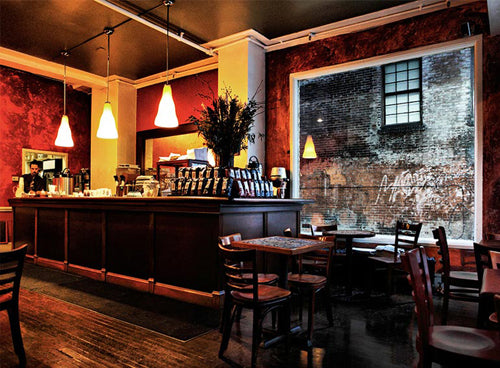
Showing posts with label coffee. Show all posts

Tuesday, July 24, 2012

Roasting: Outliers

Green (unroasted) coffee.
Haymarket House has a gas stove, so one of the first things I did upon arrival was to order some green (unroasted coffee). Gas stoves are much better than electric stoves when it comes to temperature control, and temperature control is essential for a good roast.

This post isn't the place to go into all that roasting coffee entails (for that, check here), but I will provide some tasting notes. All of the coffees that I ordered are unusual in some way or another, and roasting well (as I feel I did) them marks a new threshold in my roasting abilities.

Aged Sumatra Aceh

This is the most exotic of the coffees in the lot that I ordered. It was harvested in 2007, and sat in a dark warehouse until recently. Aging coffee is unusual: since it often results in a dulled flavor, few people are eager to produce it (plus, you tie up your warehouse for a few years holding perfectly sellable coffee). I am still not certain how folks go about aging coffees in such a way as to market them as "aged coffee." What I do know is that this method is only common in Sumatra. I roasted it twice, both times to a medium-dark profile, and it didn't disappoint. Spicy, musky and wood (cedar!) notes dominated over a silky body.

Brazil Modgliani Peaberry Natural Process

Two things make this coffee stand out from other coffees from Brazil (land of otherwise unremarkable coffee): every bean is a peaberry -- little round beans that roll differently in the roaster; and the beans were processed via the "natural process" -- the coffee fruit was removed after (rather than before) the beans were laid out in the sun to dry. Counter Culture Coffee is currently offering a natural process Ethiopian coffee which shines with blueberry and raspberry notes. This coffee was not nearly as dramatic. The fruit notes were there, over a complex, full body, but I was a little disappointed. My roasting error, probably. I'll be seeking out more natural process coffees as my roasting improves, and I still have some left to roast.

Ethiopia Yirga Cheffe Grade 1

This one was a bit of a splurge, but totally worth it. As with most of these coffees, I made two separate roasts (I get a pound at a time, and my roaster maxes out at 8oz.). The first one was very surprising: a very light body, tons of tea and lemongrass flavors. One of my housemates took a sip and thought that it WAS tea. These are the classic signs of underroasting, so in my second roast, I used less heat, but for longer time. The tea-like flavors returned, this time backed up by the floral sweetness that Yirgacheffe fans love. I hit the nail on the head with this one, I'm proud to report.

Yemen Mokha Ismaili

Mocha (Moka, Mokha, etc.) is the port that first shipped coffee to the West. People there were confused, and really into drinking hot chocolate at the time, and so Mocha is (sort of) responsible for the name of the drink that people order at coffeeshop when they want espresso mixed with chocolate

What made this coffee unusual was the instructions to "let rest three days before drinking." Most coffees are allowed to rest (left in an open container to allow CO2 to escape) for 12-24 hours immediately after roasting, before being sealed. I still don't know why this coffee must rest for so long, but I tried my first batch (a medium roast with notes of fig and chocolate in the cup) and it was delicious. The second batch is waiting its three days, so I'll report back once I've tasted it.


Monday, October 10, 2011

Roasting

I'm not sure whether this means that my job has taken over my life, or that I'm in the job for the moment. Either way, it definitely means that, as I suspected during the earthquake, coffee has taken over my life.

I have begun home roasting in earnest.

It turns out that popcorn technology and coffee-roasting technology are very similar, so, after blowing out the heating element on an air popper, I ordered a Whirley Pop.

There are plenty of places out there on the internet where the process is described, but basically, the stove (or in my case, the working electric hot plate I found on my neighbor's trash pile) heats the pot up to approximately 400 degrees F, while the crank handle agitates the coffee beans to ensure that no one bean is heated for longer than the others.

I had my first cup of properly aired and roasted coffee from the whirley pop this morning. While it was not a revelation in the sense that some coffees from professional roaster Counter Culture (served at work) have been, it was an incredibly complex cup, full of nutty flavors and subtle undertones that Counter Culture's  coffee, roasted in North Carolina 3-4 days before we get it here in Harrisburg, never have.

A little practice, some good note taking, and (hopefully!) visiting with Aaron down at local roaster Little Amps, and I'll be cranking up some exciting coffees.

Monday, September 19, 2011

Coffee Continued

I was planning on writing this bit as the final paragraph of my previous post, but it got a little long. Rather than consign it to the trash, I'll put it here.


Complications

The proliferation of cafes in recent decades is, of course, the product of coffee's Third Wave, begun in 1990s Seattle and spread across the country. Starbucks had a big role to play in this movement, and I'll spare the usual coffee-snob-hating-on-Starbucks routine to share two stories that happened during my coffee tour.

1) As I walked through the swanky Rittenhouse Square district, I passed three or four Starbucks. Inside, at the bar along the window, sat a man who I assumed was homeless: scraggly beard, dirty clothes, two bulging plastic bags tightly at his side. He swirled his paper Starbucks cup, smelled it, and sipped. His face lit up. I realize that's a cliche, but it's the only way to describe it.

2) The back alleys of the Rittenhouse Square neighborhood have their fair share of loading docks, dumpsters, and shadowy corners, and in one of them sits an old facade. Tiled and bricked in an art-deco style, faded yellows and greens barely overcoming the dust, it bore the sign "Rittenhouse Coffee."

These complicate my understanding of coffee. Apparently, crappy corporate coffee can transform someone's day . I doubt that the homeless guy would have smiled any bigger had he sipped on my pourover of Maragojipe microlot or my Sidama Macchiato. And apparently the past had its own coffee waves, come and gone, leaving behind artifacts like Rittenhouse Coffee, which has not (surprisingly enough) been revived by the current interest in 1) all things coffee and 2) all things vintage. Which leaves us with: When will our current coffee phase end, and what difference will it have made? Will Starbucks remain, making people smile, even when skilled baristas and single-origin coffees have fallen by the wayside?

Saturday, September 10, 2011

Philadelphia Coffee Pilgrimage/Evacuation

Four blocks over, two blocks down from my apartment;
the whole reason I'm even here in Philly.
I don't know if it's bad form to write about coffeeshops while using their free internet, but I'm doing it. I'm in Philly for the day, my neighborhood evacuated due to widespread central PA flooding from Tropical Storm Lee. Heather is attending a conference at one of the sports arenas, so I've ridden the Broad Street Subway two stops north to the first stop on my self-guided Philadelphia coffee tour:


I) Ultimo Coffee

The first thing I realize, approaching from the Snyder stop on the BSS is that I planned my tour backwards; Ultimo is paired with a local brewpub, but it's nine in the morning, so they're closed.  Had I arrived here later, I could've expanded this to a coffee and beer review.

Nonetheless, the coffee is wonderful. I'm starting off with a regular cup of brewed coffee, and they've got one of my favorite coffees of all time: Counter Culture's Finca El Puente, brewed with the Chemex. I've never had Chemex coffee before (it works a lot like a pourover brewer on a large scale), and this does not disappoint. Bright, with a clean finish, but not thin or watery. The experience was improved by the nearly-identifiable music over the speaker -- mellow, trippy guitar work and a familiar vocalist. It took me until halfway through my cup of coffee to identify early M. Ward.

The shop is small, but not cramped -- large corner windows let the sun shine on the battered wooden tables and the bar-style window seating. I didn't try their espresso, but the cappuccinos have well-executed latte art on the top, and they're using Apollo, so I have faith in their quality. I won't be acting on that faith -- I have a lot more caffeine to consume today, and I don't want to overload early on. I just overheard the baristas chatting about Orlando Arita, Counter Culture's latest espresso project, and one that I'll be experimenting with once I get back to Harrisburg.

A Chemex brewer.
II) Elixir Coffee

I wasn't planning on visiting Elixir, but as I searched for transit times to reach West Philly to meet up with Nathan and get to my next stop (Lovers and Madmen), Google presented me with this option, only a few blocks from my station. If Ultimo had the laid back charm of a South Philly brewery/coffeeshop, this place is all swank; located just off the Avenue of the Arts in the Walnut Street upscale shopping district, it has clean lines, wood and tile, and the smell of a spa (from the carafe of cucumber water, I think). I am seated at some of the only non-communal seating. Most of the chair space is along wooden benches at family-style tables. A nice touch, but most of the strangers sitting at them are (like me) tapping away on their screens.

Though tempted by their streetside sign ("Pour Over: Finca los Planes, Sumatra, Elida"), I decided to switch to espresso for stop number two. The Espresso Macchiato is my drink of choice, and, upon asking the barista, I learned that it would be made with a single-origin Sidama espresso. For those not familiar, single-origin espressos are a sort of coup-de-grace: most espressos are blended from coffees from a variety of sources to achieve a particular flavor. A single-origin can only be produced from an exceptional source coffee, by a roaster skilled at bringing out the minute particularities that reveal themselves in espresso.

The macchiato was (is; I'm sipping it as I write this) delicious -- the brightness of the Ethiopian coffee is evident, even as the chocolaty body is enhanced by the little bit of steamed milk in the cup. It has a complex, nutty flavor that is interesting at every sip. It makes me want another one, but I can feel my fingers starting to shake as I type. It's time to meet Nathan at the Clark Park Farmer's Market in West Philly for a break before heading to Lovers and Madmen.

III) Lovers and Madmen

Skipped the farmers market and met Abigail and Nathan here at Lovers and Madmen, just off of Market Street, near the Market-Frankford Line station at 40th Street.

Inside, the ambiance is different from the two shops before: more open space, more seating, more conversations than the two small shops before it. It might just be the time of day, but this place seems less hip and more welcoming.

I ordered a pourover coffee of Counter Culture's Maragojipe microlot. A microlot is a small portion of a coffee farm's seasonal take, usually selected by variety of coffee plant or from location within the farm (Maragojipe is the former). It is redolent of pistachio and plums, as described, so it was brewed well. The staff seemed less professional here; disconcerting in terms of expectations about coffee quality, but part of what made the place so welcoming when we walked in. The coffee is reassuring me, even as the baristas quibble about what kind of music to play.

Nathan and Abigail are sitting beside me discussing contemporary theater and literature, the kind of thing that the Scholar breeds, and the kind of thing that I haven't found at any of the coffeeshops I've visited today. Again, it might just be the company of the time of day, but this place feels like it engenders that kind of conversation. The aftertaste on that microlot doesn't quit. Even as we leave, the rum-like flavor remains on my tongue.

The counter at La Colombe.
IV) La Colombe

This place has always been my go-to spot for top-quality coffee in Center City, and yesterday's trip (yup, I'm writing from the next day now) only served to confirm this. If you can get a seat at La Colombe, it's a nice place to sit, but more often than not, the line stretches from the counter to the door, and all the seating is filled.

They focus on the espresso at La Colombe, and it shows. No menu posted, no flavored syrups, one variety of drip coffee on tap at a time; this is a place for coffee snobs. Their cappuccino is so creamy that one of my friends, upon tasting it, asked "What did you get? Hot chocolate?"

If it's variety that you seek, go elsewhere, but if you want to taste some of the best espresso beverages in the city (on the East Coast, even) go to La Colombe.


V) Conclusion

I have shied away from declaring any of these four cafes the "Best of Philly." I only visited four cafes, and my selection criteria were not at all scientific. And while La Colombe is the cafe I'll still visit the most (in part because of its central location) each of these cafes has its own charm, and should, if you get the chance, be visited. If you're heading to Ultimo anytime soon, pick me up some beer.

Tuesday, August 23, 2011

Earthquake

I roasted my first batch of coffee today. I used a popcorn popper and some green coffee beans given to me for my recent wedding. Pleased with the practice and with the smell, though concerned that coffee may be taking over my life, I brewed a cup at work. Too tangy, not enough body, I thought, so I tried it iced. Delicious. Then we had an earthquake.

It had a disappointingly small impact on my life. I do not wish for collapsing buildings and widespread disaster, but I was at least hoping to be enlightened about the transitory nature of the earth we live on; the instability of all that we find most firm; etc. All of those things that the California folks (Ben Seretan, I'm thinking of conversations with you) tell me happen to their awareness of the world, living in a place where it so often shifts itself.

Instead, some tourists visiting the bookstore hollered down from the second floor "Hey, does the floor usually move up here?" Dumbfounded at the idiocy of this question, I could not respond. The news, trickling in via customers' smartphones and friends' arrivals, changed my assessment of the tourists' intelligence.

The espresso machine pulled a few shots too short, then. The liquid dripping from the machine shifted from a dark orange brown to a blond stream within 20 seconds, and the espresso tasted sour. Having just set the grinder to pull good shots at the beginning of my shift, I was perplexed. Then I realized that there had just been an earthquake. Thus, the only effect that the earthquake had on me only reconfirmed my fears that coffee is taking over my life: Because of the East Coast earthquake of 2011, I had to recalibrate the espresso machine.

Tuesday, July 19, 2011

Fulfillment

Fulfillment -- heralded by religions and self-help books, achieved, today, by yours truly.

It was minor fulfillment, more in the sense of fulfillment of a mission than the sort of deep fulfillment promised by the above. But there is a consonance, and one that should be neither overlooked nor over-exaggerated.

It is important, for this story, to know that pour-over coffee is a brewing style currently all the rage in the coffeehouse scene. It allows the barista to control, via speed and timing of pouring, the flavor of the cup of coffee, in addition to the usual parameters of temperature of water, and the relative and actual amounts of water and coffee grounds.

All that to say, it's a way to make really good coffee or really bad coffee, and the finished product can be mostly credited to (or blamed on) the skill of the barista.

It was with a pour-over that I found fulfillment.

I poured the last bit of water through coffee grounds, let it drip into his cup, and handed it off to him. He sipped it, paused, and sipped it again.

"Ehh?" I said, asking for confirmation of what I had told him before he ordered: this was going to be good coffee.
"That is good," he said. "In fact," he paused again -- he is a very precise type of person, not one to say something unconsidered, "This is the best cup of coffee I have ever had. This--" by this point I was beaming "--is coffee non plus ultra."

Thus, I fulfilled my barista role, by making the best cup of coffee ever.

I was, it should be noted, working with great coffee to begin with: Counter Culture's Kilenso Mokonisa. Most of CC's coffees are great, but this one is the kind of coffee that makes even the untutored sit up and take notice. It is a "natural sundried coffee," which means that the fruity part of the coffee (the cherry) is left intact (surrounding the bean) while the coffee is dried in the sun for a period of a few weeks to a few months. This process allows the natural fruit flavors of the coffee cherry to leach into the coffee bean, producing a flavor like the artificially-flavored coffees (blueberry, raspberry, etc.) found in so many coffeeshops, yet far more complex and subtle.

All that to say that he was more likely to notice this coffee than any other coffee, that the pump had been primed by his awareness of pour-over as a method endorsed by the coffee-geek subculture; all that to say that he's a regular, and could have been flattering me.

But I saw his face when he first sipped that cup, and I knew then that I had done exactly what this job is all about. The idea that life can be surprising; that another world is possible; that a cup of coffee can be so much more than a cup of coffee; these are tenets of my faith, and central to my vocation, and to find them expressed so clearly in so mundane a moment at work was inspiring.

Life will go on; the struggles at the bookstore/coffeeshop are not resolved, nor is anything outside of work, but I have done it. I have made the perfect cup of coffee.

Wednesday, March 16, 2011

Ur-Text-ish: A "Cannery Row" Story and Miscellany

I just wrote a more focused post on my favorite chapter of "Cannery Row," (to be posted soon, after a bit of polishing) but I wanted to relate another story that just couldn't fit into that post. First, though, a few notes:

I) David Wax Museum featured in this interesting article. It makes me wish I had the kind of house I could host concerts in.

II) As you may have read before, I'm also blogging for my place of gainful employment, and I wrote the two most recent posts (two links!). I've added that blog to my blogroll (at right) so when it updates, you can read it there. I'll stop posting about it now. Thanks to all y'all abroad who read it; my managers, upon viewing the google analytics report, were impressed by the international audience. I was able to account for all the countries except for a small northeastern European country (Estonia? Latvia). If any of y'all are there and reading, please let me know. I am curious.


My photo of "Doc's Lab." (Western Biological, in real life)
 III) All right, the story about "Cannery Row":

Like "Moby-Dick," I read this book while studying in the Williams-Mystic Maritime Studies Program. Unlike "Moby-Dick," this reading was not the first time I had read this book. I knew I loved this book coming into the program, so during our field trip to the west coast, my literature professor, Rich King, invited me, as we sat on the docks next to the (defunct, now tourisit-ified and gentrified) canneries, to read aloud the introduction to the class. It was a surprisingly moving moment, in which the power of place was incredibly evident. I read the "disclaimer," the dedication, and the introductory passage, and by the end, was almost choking up. I am not typically moved to tears by books, yet sitting there, mere yards from Doc's lab, the Palace Flophouse and Grill, Lee Chong's, etc. I could barely help myself.

I am also not usually connected to particular books as physical objects, but my Penguin paperback of Cannery Row now contains a map of the row, sketched while I was there, and it accrues new underlinings and dog ears at every read. Both in terms of place and the book itself, "Cannery Row" is, for me, a book of physicality.

Saturday, March 5, 2011

It's Been Awhile...

...but I'm almost done with Moby-Dick, on schedule to finish before both Heather's arrival and the beginning of spring. I will post on it soon.

In other news, my workplace has started a blog, and I wrote for it today.

Friday, September 17, 2010

Two Farm Musings

I. Delicate Brutality: The Roto-Tiller

Machinery, in particular power tools of the farm and the woodshop, is both brutal and delicate; I challenge anyone to find other things that embody that unlikely pairing.

The roto-tiller's blades cut through the grass and soil, tearing them apart and turning them upside down with efficiency and brutality. The first garden snake to encounter the machine received a wound that did not prove immediately fatal, but gave me enough remorse to take the time to toss the second one into the brush pile, not trusting its instincts for dealing with the machine.

Despite this ability to so quickly destroy and overturn so much, the roto-tiller is also sensitive, like a poet or the fine-adjustment knob on a coffee grinder or a sextant. Roots, stones, and the fragments of brick and glass that remind me of the urban part of this urban farm can all cause it to cough and shudder, and sometimes jam the blades. Slight hummocks and valleys in the field drive the machine perceptibly off course, and the heavy spinning blades only reinforce the false directions. It seems incongruous: these are exactly the things that roto-tillers encounter in regular operation, yet these are the things that are its downfall.


II. Refinement: Espresso and Compost

Compost, I realized while sifting it into a wheelbarrow, is not unlike espresso. Before I continue, let me elaborate on compost sifting. After many other, longer-term processes, the compost is ready to be spread on a field. First, however, the larger pieces that have not decomposed (twigs, rinds, etc.) need to be removed. So I laid two boards parallel across the sides of the wheelbarrow and laid the sifter on it. The sifter is a square wooden frame with mesh nailed to the bottom. Once I've shoveled two shovelfuls of compost onto the mesh, I slide it back and forth along the boards. Any more than two, and it will jam; that is, there will not be enough space in the frame for the compost to shake about and settle the small pieces through the mesh. The wet hot compost rubs into the grain of the parallel boards and lubricates the frame's sliding. Once the wheelbarrow is full, it gets dumped into a compost hopper, stored in the heat of the day until it is needed.

All that to say that compost is like espresso, because both are a fine brown powder. On one hand they are different: compost is the lowest form; the beginnings, the primordial ooze from which plants, perhaps coffee plants, will emerge. Espresso is, on the other hand, the highest and most refined form: grown, dried, roasted, ground, and brewed, with any number of trans-continental shipments in between those steps. It comes served as a liquid in a tiny cup in a refined atmosphere in the artsy part of town, while compost fills wheelbarrows and is spread by sunburned men and women on an acre lot amidst Section 8 housing, across the street from an auto body shop.

But compost, too, is a refined form, its temperature is taken throughout the process. It is turned multiple times, mixed, and cared for. The sifting process and the process of pulling a shot have a similar number of steps. And the espresso grounds, the little puck that falls out of the filter between drinks, can, in the best of circumstances, make its way to compost pile, continuing the be refined.