Erasmo came into the store carrying a bag of "Spicy Beef Stick Bits & Ends" and wearing army-style dog tags.
"Hey," he said, "can you guys help me out?"
"We can try," said Liz, "Whattya need?"
"I need someone who speaks French. Or Arabic."
We looked around the store. It was Saturday night, so it was fairly crowded. None of my friends there spoke French or Arabic. Nathan was also sitting at the counter.
"Why do you need that?" he said.
"Well..." Erasmo took a deep breath and ate another beef stick, "There's this pretty Moroccan chick who moved in next door to me."
"Ahhhh," we all said.
"Yeah," he said, "And playing charades hasn't been working out so well. I mean, how do you say 'you're pretty' in charades?"
"Point at something pretty?" said Liz.
"Then I'd point at myself," he said.
"And that would just confuse her," said Nathan.
We shrugged. Erasmo offered us some bits & ends (only Nathan took him up on that), and left the store for his cross-linguistic rendezvous.
Showing posts with label Midtown Scholar. Show all posts
Showing posts with label Midtown Scholar. Show all posts
Tuesday, October 5, 2010


Sunday, September 19, 2010
Nighthawks
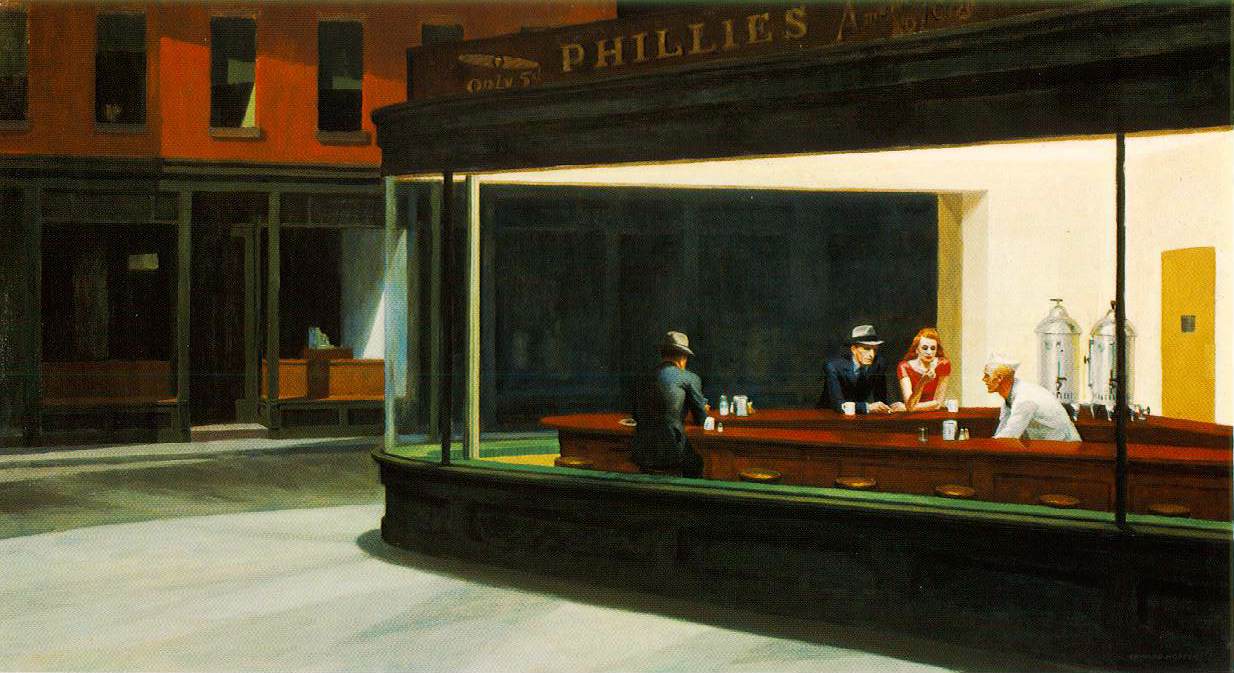
For one, the silver coffee machines. Not exactly like the giant copper-and-brass eagle that sits astride our espresso machine, but the shape is the same. Secondly, the customers: ensconced in their seats, making their drinks last longer than they probably should, just to stay inside and enjoy the light for a while. Just like our regulars. Thirdly, the windows: the Scholar's storefront is completely glass, the view blocked only by a few concert posters and bus schedules. Perhaps most uncannily, The street, with its abandoned-but-still-respectable buildings is a dead ringer for Third Street in Midtown. You'll have to come here and see it sometime.
Antonio
An important part of my training at Midtown Scholar has been learning to identify the regulars. When some particular someones walk in, my co-worker or co-workers will glance significantly at the new arrival and say to me, "Oh, that's Monica, she's--" usually at this point, the new arrival will have reached the bar, and my tutor will have to turn away: "Hi Monica, how are you doing today?" leaving me to ascertain this particular regular's foibles on my own.
But the other day, Liz was able to say to me "that's Antonio. He's a voodou priest. Hi Antonio, what can I get for you?"
Antonio is a short man who wears, without fail: 1) a pair of sturdy work pants that bunch up around the tops of his boots. 2) said boots. 3) a black Sikh-style turban. That day, and every time I've seen him since, he's carried an unlit cigar, which he uses to punctuate a chosen few of his already-sparse remarks.
The first time I met Antonio, he and Liz got to talking about our discount book trucks out in front of the store. "I saw this little kit out there Antonio, it made me think of you because it was a voodou kit, and they had spelled voodou the right way, with a 'u.'"
Antonio looked up from the soda fountain where he was filling his cup with ice.
"A voodou kit, you say?" he said. Liz nodded. Antonio came over to the bar and tapped his cigar against the edge of the rail. "Now Liz," he said "You know I am a deeply spiritual person, and I know you are a spiritual person as well. I think you should not be selling that thing here. That kind of thing is not good for a place." "Well," said Liz, "it's right out on the cart out front."
He paused, unsure whether to fill his soda or begin his mission. He set the empty cup on the bar and passed through the doors.
"Once," said Liz, "Antonio told me my fortune--"
But then another customer came in through the door. Later, Antonio picked up his soda cup with a shrug--the voodou box was nowhere to be found.
But the other day, Liz was able to say to me "that's Antonio. He's a voodou priest. Hi Antonio, what can I get for you?"
Antonio is a short man who wears, without fail: 1) a pair of sturdy work pants that bunch up around the tops of his boots. 2) said boots. 3) a black Sikh-style turban. That day, and every time I've seen him since, he's carried an unlit cigar, which he uses to punctuate a chosen few of his already-sparse remarks.
The first time I met Antonio, he and Liz got to talking about our discount book trucks out in front of the store. "I saw this little kit out there Antonio, it made me think of you because it was a voodou kit, and they had spelled voodou the right way, with a 'u.'"
Antonio looked up from the soda fountain where he was filling his cup with ice.
"A voodou kit, you say?" he said. Liz nodded. Antonio came over to the bar and tapped his cigar against the edge of the rail. "Now Liz," he said "You know I am a deeply spiritual person, and I know you are a spiritual person as well. I think you should not be selling that thing here. That kind of thing is not good for a place." "Well," said Liz, "it's right out on the cart out front."
He paused, unsure whether to fill his soda or begin his mission. He set the empty cup on the bar and passed through the doors.
"Once," said Liz, "Antonio told me my fortune--"
But then another customer came in through the door. Later, Antonio picked up his soda cup with a shrug--the voodou box was nowhere to be found.
Friday, September 17, 2010
Two Farm Musings
I. Delicate Brutality: The Roto-Tiller
Machinery, in particular power tools of the farm and the woodshop, is both brutal and delicate; I challenge anyone to find other things that embody that unlikely pairing.
The roto-tiller's blades cut through the grass and soil, tearing them apart and turning them upside down with efficiency and brutality. The first garden snake to encounter the machine received a wound that did not prove immediately fatal, but gave me enough remorse to take the time to toss the second one into the brush pile, not trusting its instincts for dealing with the machine.
Despite this ability to so quickly destroy and overturn so much, the roto-tiller is also sensitive, like a poet or the fine-adjustment knob on a coffee grinder or a sextant. Roots, stones, and the fragments of brick and glass that remind me of the urban part of this urban farm can all cause it to cough and shudder, and sometimes jam the blades. Slight hummocks and valleys in the field drive the machine perceptibly off course, and the heavy spinning blades only reinforce the false directions. It seems incongruous: these are exactly the things that roto-tillers encounter in regular operation, yet these are the things that are its downfall.
II. Refinement: Espresso and Compost
Compost, I realized while sifting it into a wheelbarrow, is not unlike espresso. Before I continue, let me elaborate on compost sifting. After many other, longer-term processes, the compost is ready to be spread on a field. First, however, the larger pieces that have not decomposed (twigs, rinds, etc.) need to be removed. So I laid two boards parallel across the sides of the wheelbarrow and laid the sifter on it. The sifter is a square wooden frame with mesh nailed to the bottom. Once I've shoveled two shovelfuls of compost onto the mesh, I slide it back and forth along the boards. Any more than two, and it will jam; that is, there will not be enough space in the frame for the compost to shake about and settle the small pieces through the mesh. The wet hot compost rubs into the grain of the parallel boards and lubricates the frame's sliding. Once the wheelbarrow is full, it gets dumped into a compost hopper, stored in the heat of the day until it is needed.
All that to say that compost is like espresso, because both are a fine brown powder. On one hand they are different: compost is the lowest form; the beginnings, the primordial ooze from which plants, perhaps coffee plants, will emerge. Espresso is, on the other hand, the highest and most refined form: grown, dried, roasted, ground, and brewed, with any number of trans-continental shipments in between those steps. It comes served as a liquid in a tiny cup in a refined atmosphere in the artsy part of town, while compost fills wheelbarrows and is spread by sunburned men and women on an acre lot amidst Section 8 housing, across the street from an auto body shop.
But compost, too, is a refined form, its temperature is taken throughout the process. It is turned multiple times, mixed, and cared for. The sifting process and the process of pulling a shot have a similar number of steps. And the espresso grounds, the little puck that falls out of the filter between drinks, can, in the best of circumstances, make its way to compost pile, continuing the be refined.
Machinery, in particular power tools of the farm and the woodshop, is both brutal and delicate; I challenge anyone to find other things that embody that unlikely pairing.
The roto-tiller's blades cut through the grass and soil, tearing them apart and turning them upside down with efficiency and brutality. The first garden snake to encounter the machine received a wound that did not prove immediately fatal, but gave me enough remorse to take the time to toss the second one into the brush pile, not trusting its instincts for dealing with the machine.
Despite this ability to so quickly destroy and overturn so much, the roto-tiller is also sensitive, like a poet or the fine-adjustment knob on a coffee grinder or a sextant. Roots, stones, and the fragments of brick and glass that remind me of the urban part of this urban farm can all cause it to cough and shudder, and sometimes jam the blades. Slight hummocks and valleys in the field drive the machine perceptibly off course, and the heavy spinning blades only reinforce the false directions. It seems incongruous: these are exactly the things that roto-tillers encounter in regular operation, yet these are the things that are its downfall.
II. Refinement: Espresso and Compost
Compost, I realized while sifting it into a wheelbarrow, is not unlike espresso. Before I continue, let me elaborate on compost sifting. After many other, longer-term processes, the compost is ready to be spread on a field. First, however, the larger pieces that have not decomposed (twigs, rinds, etc.) need to be removed. So I laid two boards parallel across the sides of the wheelbarrow and laid the sifter on it. The sifter is a square wooden frame with mesh nailed to the bottom. Once I've shoveled two shovelfuls of compost onto the mesh, I slide it back and forth along the boards. Any more than two, and it will jam; that is, there will not be enough space in the frame for the compost to shake about and settle the small pieces through the mesh. The wet hot compost rubs into the grain of the parallel boards and lubricates the frame's sliding. Once the wheelbarrow is full, it gets dumped into a compost hopper, stored in the heat of the day until it is needed.
All that to say that compost is like espresso, because both are a fine brown powder. On one hand they are different: compost is the lowest form; the beginnings, the primordial ooze from which plants, perhaps coffee plants, will emerge. Espresso is, on the other hand, the highest and most refined form: grown, dried, roasted, ground, and brewed, with any number of trans-continental shipments in between those steps. It comes served as a liquid in a tiny cup in a refined atmosphere in the artsy part of town, while compost fills wheelbarrows and is spread by sunburned men and women on an acre lot amidst Section 8 housing, across the street from an auto body shop.
But compost, too, is a refined form, its temperature is taken throughout the process. It is turned multiple times, mixed, and cared for. The sifting process and the process of pulling a shot have a similar number of steps. And the espresso grounds, the little puck that falls out of the filter between drinks, can, in the best of circumstances, make its way to compost pile, continuing the be refined.
Wednesday, September 8, 2010
The Scholar, my place of gainful employment


There it is. Note my bosses, Kinsey and Beth conferring behind the counter. When it's slow in the coffee bar, we have espresso time trials and informal tea tastings. My caffeine tolerances have yet to catch up with the amounts I am consuming.

There's Grandma in the bookstore, reading an appropriate book.
Subscribe to:
Posts (Atom)