Erasmo came into the store carrying a bag of "Spicy Beef Stick Bits & Ends" and wearing army-style dog tags.
"Hey," he said, "can you guys help me out?"
"We can try," said Liz, "Whattya need?"
"I need someone who speaks French. Or Arabic."
We looked around the store. It was Saturday night, so it was fairly crowded. None of my friends there spoke French or Arabic. Nathan was also sitting at the counter.
"Why do you need that?" he said.
"Well..." Erasmo took a deep breath and ate another beef stick, "There's this pretty Moroccan chick who moved in next door to me."
"Ahhhh," we all said.
"Yeah," he said, "And playing charades hasn't been working out so well. I mean, how do you say 'you're pretty' in charades?"
"Point at something pretty?" said Liz.
"Then I'd point at myself," he said.
"And that would just confuse her," said Nathan.
We shrugged. Erasmo offered us some bits & ends (only Nathan took him up on that), and left the store for his cross-linguistic rendezvous.
Tuesday, October 5, 2010


Thursday, September 30, 2010
The Low Anthem
The Low Anthem is coming to Harrisburg on Monday, November 8th, at 7PM. Tickets are $10. If you ever needed an excuse to come visit me, here it is. Floor space will be provided for those wanting to stay the night.
Friday, September 24, 2010
An Open Letter to Ira Glass
Dear Sir,
Though it has no bearing on how you will conduct your radio program in the future, I would like to share a few ways in which This American Life has affected my particular American life.
Our letter today has three acts, detailing my particular interactions with This American Life.
Act One: Depression
No, not the clincal/chemical mental health diagnosis, just a general malaise that arises just about every time I listen to an episode of This American Life. An example: your show of March 27, 2007, in which you profiled New York City's prank/guerilla theater troupe Improv Everywhere. I love Improv Everywhere, and have participated in copycat and inspired-by groups. So it was with great pleasure when I heard you announce that you were profiling Improv Everywhere. This pleasure turned to a growing sense of dread when I realized that you were profiling Improv Everywhere's failures.
You yourself, Mr. Glass, have suggested that many of your shows deal with the "crypto-theme" of wrongness. Perhaps this is why I find listening to your show to be an existentially painful experience. I do not enjoy wrongness in myself, or hearing about how others are wrong. This is not only the case with Improv Everywhere, to whom I have some emotional connection. I am even depressed by episodes whose subjects have no connection to me whatsoever. It is the fact of the wrongness and failure inherent in so many of your shows that depresses me.
It took much listening to your show to realize that this was the case, but even once I realized that This American Life was not having a positive impact on my emotional state, I did not stop listening. Depressed is not necessarily a negative review, coming from me. Some of my favorite music (The Low Anthem), movies (Aguirre, The Wrath of God), and books (Hemingway in general) leave me with a feeling of hopelessness about the world in general, and, contradictory as it may sound, this feeling is not always unpleasant. Knowing this about myself, I kept listening to your show.
Act Two: Redemption
Until I stopped, and swore off This American Life for lighter radio fare (Car Talk; All Songs Considered). But then a friend sent me a link to your show of August 28, 1998. Entitled "Notes On Camp," it chronicled various summer camp experiences. Both this friend and I had been co-workers at a summer camp.
I listened through the entire episode, cringing as each act ended and a new one began, waiting for the revelation that would turn the whole experience sour.
It never came. I listened through the stories of color days, of camp crushes, of bloody mary and comic hijinks in Israeli army camp. None of it aroused that creeping unhappiness that accompanies most every other episode of This American Life.
I was shocked. I listened to the whole piece again, and again, no malaise. Only minor annoyance at the girls' repetitive "D-A-V-E-Y DAVEY!" song. The piece evoked some pleasant nostalgia for my own summer camp days, and gave cause to meditate on summer camp's deeper meaning: "[camp] is using all the stagecraft that all the world's religions have always used... but for an entirely secular purpose: to thrill children."
This American Life was, perhaps, redeemed.
Act Three: Prequel
Now, however, we must go back to the beginning. I had heard snippets on the radio, and heard my college friends dropping your name, Mr. Glass, with great reverence. But this world is saturated with so much media, and there are fewer hours in the days than there are hours of quality recorded entertainment, so I passed This American Life on by.
My formative experiences with your show occurred on a road trip. It was a situation that would perhaps make a worthwhile setup for a future episode of your show: a friend set up the trip, then found herself delayed, leaving me to ride south from Pennsylvania to Louisiana with a minivan of people I had never met. She met up with us in New Orleans, but on the southbound trip and then again on the homeward trip, we listened to This American Life.
We clocked more than 30 hours of driving, not all (but a significant portion) of it accompanied by the sound of your voice, Mr. Glass. It was on this trip that the seeds of doubt were planted in my mind: would every episode leave me feeling like the world was a place of glum failure?
Regardless, we listened to many, many episodes, so it wasn't so unexpected when, at a later stage in the same journey, sans minivan full of friends, I walked into a New York City bakery and heard your voice from the loudspeakers.
It was early January--the cold, cold January of 2009--temperatures hovering around zero. I wore a huge old army surplus backpack, stuffed with two weeks of clothes. New Orleans clothes, not New York clothes. I was wearing my only two long-sleeved shirts, with multiple t-shirts layered underneath. I was cold and hungry, without a warm place to stay for another eight hours, and without spare cash. I looked and felt like one of New York's many unfortunate homeless. Later that day, in fact, I would stand in a subway station and ask passersby to swipe their Metrocard to get me into the subway (to no avail). When I stepped into that bakery, all I wanted was one of the cookies on the full, hot cookie sheets they were drawing out of the oven. Just one, to put some warmth inside of me.
I don't know why, but I didn't suppose that engaging the baker in conversation about This American Life -- the episode playing over the speakers, the same episode I had recently heard in the van on the way through Washington D.C. -- would get me a free cookie. Of course (as you, the consummate storyteller, must have guessed) it did. As we discussed the story of the baby-doll salesgirl and the unfortunate ramifications of the colors of the dolls' skins, she pulled a new sheet of chocolate chip walnut cookies out of the oven, and handed one across the counter.
Epilogue
So, Mr. Glass, despite the emotional turmoil that your show has, and continues to put me through, I owe you a debt of gratitude. In my moment of great need, a passing familiarity with your program got me exactly what I needed, when nothing else could have.
Since listening to that fateful summer camp episode, I have not listened to your show. My hesitation is too great--I have reached a place where I am at peace with This American Life, and if I were to pursue your show any further, that delicate equilibrium might be upset.
As someone who also appreciates and aspires to the art of storytelling, I respect your work, but have come to understand that it is not for me.
Best of luck with the program,
G. S. Albright
Though it has no bearing on how you will conduct your radio program in the future, I would like to share a few ways in which This American Life has affected my particular American life.
Our letter today has three acts, detailing my particular interactions with This American Life.
Act One: Depression
No, not the clincal/chemical mental health diagnosis, just a general malaise that arises just about every time I listen to an episode of This American Life. An example: your show of March 27, 2007, in which you profiled New York City's prank/guerilla theater troupe Improv Everywhere. I love Improv Everywhere, and have participated in copycat and inspired-by groups. So it was with great pleasure when I heard you announce that you were profiling Improv Everywhere. This pleasure turned to a growing sense of dread when I realized that you were profiling Improv Everywhere's failures.
You yourself, Mr. Glass, have suggested that many of your shows deal with the "crypto-theme" of wrongness. Perhaps this is why I find listening to your show to be an existentially painful experience. I do not enjoy wrongness in myself, or hearing about how others are wrong. This is not only the case with Improv Everywhere, to whom I have some emotional connection. I am even depressed by episodes whose subjects have no connection to me whatsoever. It is the fact of the wrongness and failure inherent in so many of your shows that depresses me.
It took much listening to your show to realize that this was the case, but even once I realized that This American Life was not having a positive impact on my emotional state, I did not stop listening. Depressed is not necessarily a negative review, coming from me. Some of my favorite music (The Low Anthem), movies (Aguirre, The Wrath of God), and books (Hemingway in general) leave me with a feeling of hopelessness about the world in general, and, contradictory as it may sound, this feeling is not always unpleasant. Knowing this about myself, I kept listening to your show.
Act Two: Redemption
Until I stopped, and swore off This American Life for lighter radio fare (Car Talk; All Songs Considered). But then a friend sent me a link to your show of August 28, 1998. Entitled "Notes On Camp," it chronicled various summer camp experiences. Both this friend and I had been co-workers at a summer camp.
I listened through the entire episode, cringing as each act ended and a new one began, waiting for the revelation that would turn the whole experience sour.
It never came. I listened through the stories of color days, of camp crushes, of bloody mary and comic hijinks in Israeli army camp. None of it aroused that creeping unhappiness that accompanies most every other episode of This American Life.
I was shocked. I listened to the whole piece again, and again, no malaise. Only minor annoyance at the girls' repetitive "D-A-V-E-Y DAVEY!" song. The piece evoked some pleasant nostalgia for my own summer camp days, and gave cause to meditate on summer camp's deeper meaning: "[camp] is using all the stagecraft that all the world's religions have always used... but for an entirely secular purpose: to thrill children."
This American Life was, perhaps, redeemed.
Act Three: Prequel
Now, however, we must go back to the beginning. I had heard snippets on the radio, and heard my college friends dropping your name, Mr. Glass, with great reverence. But this world is saturated with so much media, and there are fewer hours in the days than there are hours of quality recorded entertainment, so I passed This American Life on by.
My formative experiences with your show occurred on a road trip. It was a situation that would perhaps make a worthwhile setup for a future episode of your show: a friend set up the trip, then found herself delayed, leaving me to ride south from Pennsylvania to Louisiana with a minivan of people I had never met. She met up with us in New Orleans, but on the southbound trip and then again on the homeward trip, we listened to This American Life.
We clocked more than 30 hours of driving, not all (but a significant portion) of it accompanied by the sound of your voice, Mr. Glass. It was on this trip that the seeds of doubt were planted in my mind: would every episode leave me feeling like the world was a place of glum failure?
Regardless, we listened to many, many episodes, so it wasn't so unexpected when, at a later stage in the same journey, sans minivan full of friends, I walked into a New York City bakery and heard your voice from the loudspeakers.
It was early January--the cold, cold January of 2009--temperatures hovering around zero. I wore a huge old army surplus backpack, stuffed with two weeks of clothes. New Orleans clothes, not New York clothes. I was wearing my only two long-sleeved shirts, with multiple t-shirts layered underneath. I was cold and hungry, without a warm place to stay for another eight hours, and without spare cash. I looked and felt like one of New York's many unfortunate homeless. Later that day, in fact, I would stand in a subway station and ask passersby to swipe their Metrocard to get me into the subway (to no avail). When I stepped into that bakery, all I wanted was one of the cookies on the full, hot cookie sheets they were drawing out of the oven. Just one, to put some warmth inside of me.
I don't know why, but I didn't suppose that engaging the baker in conversation about This American Life -- the episode playing over the speakers, the same episode I had recently heard in the van on the way through Washington D.C. -- would get me a free cookie. Of course (as you, the consummate storyteller, must have guessed) it did. As we discussed the story of the baby-doll salesgirl and the unfortunate ramifications of the colors of the dolls' skins, she pulled a new sheet of chocolate chip walnut cookies out of the oven, and handed one across the counter.
Epilogue
So, Mr. Glass, despite the emotional turmoil that your show has, and continues to put me through, I owe you a debt of gratitude. In my moment of great need, a passing familiarity with your program got me exactly what I needed, when nothing else could have.
Since listening to that fateful summer camp episode, I have not listened to your show. My hesitation is too great--I have reached a place where I am at peace with This American Life, and if I were to pursue your show any further, that delicate equilibrium might be upset.
As someone who also appreciates and aspires to the art of storytelling, I respect your work, but have come to understand that it is not for me.
Best of luck with the program,
G. S. Albright
Monday, September 20, 2010
Get Low & Winter's Bone
On Saturday, I went to Harrisburg's Midtown Cinema to see "Get Low." You may remember my being very excited about this movie based on the trailer(s) a few months ago. I've also recently attended the Midtown Cinema to see "Winter's Bone." The two movies bear a comparison.
 |
| "No Damn Trespassing." |
Let me start by recommending "Get Low." Robert Duvall and Bill Murray turn in amazing performances. The movie itself is nothing special; a period piece based on a true story featuring a few outstanding shots and mediocre pacing. It is, in some ways, a mystery movie. Duvall's character (Felix Bush)'s intentions are never clear, and the all events that follow might, or perhaps might not, be his doing. Bill Murray is the money-loving undertaker who is willing to go the extra mile for... Felix's sake? for his own sake? That mystery also unfolds, though is resolved much less satisfactorily than the story's central mystery: What lies in Felix Bush's past? The reveal (don't worry, I won't spoil it) is a masterpiece of acting. Duvall stands onstage and tells a story and the camera shows admirable restraint. We see him telling his story. We see the reactions of the important characters. We see no flashbacks or cutaways. This movie knows its strengths, and uses them well.
"Winter's Bone" has some similarities: a story set in rural America that unfolds into a suspenseful mystery. The difference is that Winter's Bone is set in the contemporary Ozarks in the midst of a meth-cooking extended family. When her father posts her family's house as bail, Ree Dolly (Jennifer Lawrence) sets out to find him in order to save the family.
 |
| The guy on the left is not Viggo Mortensen, but he could be. |
Unlike "Get Low," the mystery here is simple: where is he? Unlike "Get Low" this movie's strength is in its atmosphere. The acting is believable, the suspense works, at time achieving Hitchcockian proportions (e.g. The scene when the cops pull over the pickup truck. That's all I'll say). The movie's greatest success, though, is in selling this slice of rural America. At times feeling like a mob movie, at times like a noir, at times like a coming-of-age story, it maintains its cold blue gaze on Ree and her extended family, and
the minutiae that define their lives (sharing recently-killed vension, teaching a five-year-old to hunt squirrel, first-name familiarity with the bail-bondsman). It is this atmosphere that makes "Winter's Bone" a memorable movie, and (I hesitate to say this, considering how much I hyped "Get Low") the better of the two.
But go see them both, and let me know what you think.
P.S. I really wanted to title this post "Got Low," but then I decided to incorporate "Winter's Bone" as well. Just wanted to let y'all know.
Traveling to Swarthmore
This coming Sunday, 9/26 I will be in Philadelphia, then at Swarthmore for pasta bar. If you read this blog and will be in the area, I hope to see you there.
Sunday, September 19, 2010
Nighthawks
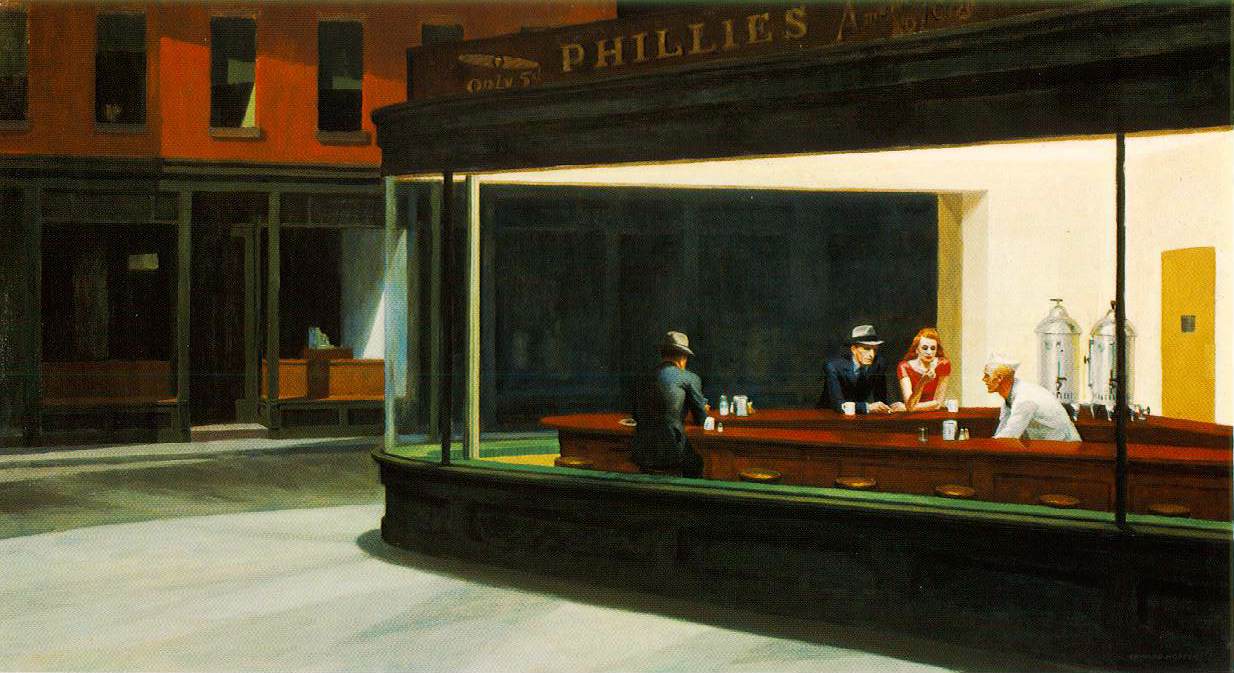
For one, the silver coffee machines. Not exactly like the giant copper-and-brass eagle that sits astride our espresso machine, but the shape is the same. Secondly, the customers: ensconced in their seats, making their drinks last longer than they probably should, just to stay inside and enjoy the light for a while. Just like our regulars. Thirdly, the windows: the Scholar's storefront is completely glass, the view blocked only by a few concert posters and bus schedules. Perhaps most uncannily, The street, with its abandoned-but-still-respectable buildings is a dead ringer for Third Street in Midtown. You'll have to come here and see it sometime.
Antonio
An important part of my training at Midtown Scholar has been learning to identify the regulars. When some particular someones walk in, my co-worker or co-workers will glance significantly at the new arrival and say to me, "Oh, that's Monica, she's--" usually at this point, the new arrival will have reached the bar, and my tutor will have to turn away: "Hi Monica, how are you doing today?" leaving me to ascertain this particular regular's foibles on my own.
But the other day, Liz was able to say to me "that's Antonio. He's a voodou priest. Hi Antonio, what can I get for you?"
Antonio is a short man who wears, without fail: 1) a pair of sturdy work pants that bunch up around the tops of his boots. 2) said boots. 3) a black Sikh-style turban. That day, and every time I've seen him since, he's carried an unlit cigar, which he uses to punctuate a chosen few of his already-sparse remarks.
The first time I met Antonio, he and Liz got to talking about our discount book trucks out in front of the store. "I saw this little kit out there Antonio, it made me think of you because it was a voodou kit, and they had spelled voodou the right way, with a 'u.'"
Antonio looked up from the soda fountain where he was filling his cup with ice.
"A voodou kit, you say?" he said. Liz nodded. Antonio came over to the bar and tapped his cigar against the edge of the rail. "Now Liz," he said "You know I am a deeply spiritual person, and I know you are a spiritual person as well. I think you should not be selling that thing here. That kind of thing is not good for a place." "Well," said Liz, "it's right out on the cart out front."
He paused, unsure whether to fill his soda or begin his mission. He set the empty cup on the bar and passed through the doors.
"Once," said Liz, "Antonio told me my fortune--"
But then another customer came in through the door. Later, Antonio picked up his soda cup with a shrug--the voodou box was nowhere to be found.
But the other day, Liz was able to say to me "that's Antonio. He's a voodou priest. Hi Antonio, what can I get for you?"
Antonio is a short man who wears, without fail: 1) a pair of sturdy work pants that bunch up around the tops of his boots. 2) said boots. 3) a black Sikh-style turban. That day, and every time I've seen him since, he's carried an unlit cigar, which he uses to punctuate a chosen few of his already-sparse remarks.
The first time I met Antonio, he and Liz got to talking about our discount book trucks out in front of the store. "I saw this little kit out there Antonio, it made me think of you because it was a voodou kit, and they had spelled voodou the right way, with a 'u.'"
Antonio looked up from the soda fountain where he was filling his cup with ice.
"A voodou kit, you say?" he said. Liz nodded. Antonio came over to the bar and tapped his cigar against the edge of the rail. "Now Liz," he said "You know I am a deeply spiritual person, and I know you are a spiritual person as well. I think you should not be selling that thing here. That kind of thing is not good for a place." "Well," said Liz, "it's right out on the cart out front."
He paused, unsure whether to fill his soda or begin his mission. He set the empty cup on the bar and passed through the doors.
"Once," said Liz, "Antonio told me my fortune--"
But then another customer came in through the door. Later, Antonio picked up his soda cup with a shrug--the voodou box was nowhere to be found.
Subscribe to:
Posts (Atom)