Sunday, August 12, 2012

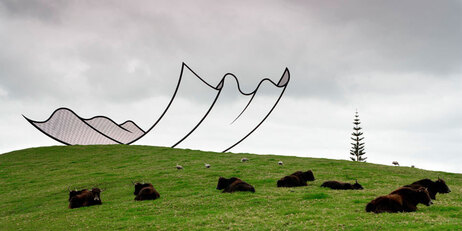
IS THIS REAL LIFE?

Yes it is.

NPR has the story here.

Let me use this brief post to say that stuff like this always makes me happy.

1) Because it is art that interacts so straightforwardly with everyday life and

2) Because the addition of the wildlife (perhaps more accurately, tame-life; livestock?) speaks directly to the child in me; the same child who spent time growing up at the local dairy farm having conversations with the cows.

Friday, August 10, 2012

Untitled


Just north of the Chicago River, the river that was reversed -- the river that's more of an urban canal than a true river like the ebullient, island-studded Susquehanna -- there's a door. 

Down along the river, below street level, but above the waterline, like the holes where the groundhogs dig in along real rivers, are the waterfront cafes and restaurants.

The steel bridges cross the river at a thousand points. These bridges are the truth of Chicago, their top arches of sinuous steel, not the pure triangles of the Rust Belt. They are straining towards respectability, and that straining imparts the arches with a rough beauty. Elegant but naked, they stretch across the reversed river.

Clark Street walks on the back of one of these bridges, north, out of the Loop. On the western side, between a bakery and a CVS drugstore, the big brown door could almost be overlooked.

Like the bridges, it strains. It wants to evoke hiddenness, so it must hide, at least halfheartedly. The hiding, however, is a ruse; it wants to be noticed. It is the door to a speakeasy.

Inside, the long black staircase is exposed to the rooms beneath, at the level of the cafes: below the street, above the waterline, though the waterline is two blocks south. 

The room is cavernous: large and dark, yes, but also like a cavern in that its size contains small nooks with tables and booths. They have curtains drawn across them and those curtains leak light onto the main floor. Dapper servers appear and disappear. Around every corner, it seems that there is a different bar, with different bartenders all dressed in black vests and starched white shirts. At the deep end of the cavern, a jazz quintet tuned up.

Not quite well-dressed, well-spoken, or well-funded enough to secure a table, we found some deep armchairs, forgotten in a corner. We watched the light from the outside as the doorman opened that large, straining door. At the top of the steps, everyone assessed the plunge, and the staff assessed everyone. We ourselves had been so assessed, and that was why we were sitting in the corner in red armchairs, the waitstaff passing back and forth in front of us. 

It was what we wanted. We didn't want the expensive food, and we didn't want to drink more once the drinks were gone. We, too, were straining.

The staff's caps and suspenders, their somber airs, enhanced the illusion of hiddenness, but the patrons undid it. They, too, were straining. They gave off the forced air of "this is a good time." Their sidelong glances at each other, at the staff, at the man or woman down the bar, undid them. 

At the end of our glasses, having taken too many sips of melting ice, having visited the bathroom, having waited for the right tempo, we stood up. We walked the length of the room, dodging those noticing and being noticed and remaining ourselves unnoticed until we stepped up by the band. They overshadowed the dance floor, the trumpet player occasionally leaning over a railing to blast a figure out of the cavern, towards the stairs.

We hadn't danced in a few months, not to a live band, not with so many people noticing. We two-stepped, swung out, and remembered. We only watched each other, and we took up half the floor until a few others got up to dance. Then we danced close, following the traditional Lindyhop "slot" back and forth on the floor. From the hidden alcoves, a woman watched us, smiling. When we stopped between dances for water, the bartender shook hands. 

We danced once more and then left. We had stopped straining, and had let the river flow in us. We stopped on the bridge on our way back south.


View Larger Map
Thursday, August 9, 2012

David Wax is Back!

For those of you who weren't reading back in February 2011, or who had forgotten, there's this great band called David Wax Museum. Soon, they'll be releasing an album, and now, as part of their promotion for that album, you can download a pay-what-you-wish sampler of their work: two preview tracks, two old tracks, and a live recording. It's  below, or at this address: http://noisetrade.com/davidwaxmuseum

I cannot vouch for the spamminess or lack thereof at Noisetrade.com, having just downloaded this sampler myself. I can, however, vouch for this awesome band.

I vouched for them in the post linked at the top (and seriously, it's linked right here, just read it).

This is one of the bands that I would go to see at any time. They've taken popular/independent music's now-waning interest in American folk music and done something really unique with it. As anyone who listens to a lot of the current folk-revival movement can confirm, that's not easy to do. Also, they put on a killer live show.

Sunday, July 29, 2012

Games

The players cooperate to explore the "House on the Hill"
... until one of them turns traitor
I've been playing and thinking about games a lot. Haymarket House has an excellent collection of board, card, and other games. I've been interested in cooperative games (not in the game theory sense) as a result of playing Pandemic! and Betrayal at House on the Hill.

In the purest form of these games, the entire group of players wins or loses together. As its title might indicate, "Betrayal" introduces a competitive element (usually one "traitor" against the group) partway through, though the first portion of the game is entirely cooperative.

I really enjoy these games: it feels good to use the resources of the game playing group to work against the game, rather than against each other. "Pandemic," for instance, is very difficult, and winning without bending the rules feels great for everyone involved.

As a result of my fascination with this kind of gameplay, I've been working on a set of rules for a cooperative game. If you are interested in proof-reading these rules, let me know.

I'm looking for readers who play games and like conceptualizing rules. In particular, I'm hoping to find places where players can, whether through malicious intent or through accidental action, find themselves in a place where the rules are inadequate or do not apply.

The other thing is that I'm conceiving this game as a live-action game, to be played in downtown Chicago.

More to come as it develops!


Friday, July 27, 2012

Go Trolls!

There he is.
Today, a blue Prius drove through the intersection at 55th and Dorchester. Painted on its side: Trinity Christian College. Painted on the back: Go Trolls!

It turns out that Trinity Christian College, located in Palos Heights, southwest of Chicago, has a large blue troll for its mascot. Knowing anything about internet slang, and the propensity of some Christians' behavior as internet commenters, a troll seems like the last thing a Christian college would want for a mascot.

No one (that I could find in my five minutes of googling) seems to see any connection or negative repercussions for the trolls here (e.g. this sports site or the school's own athletics dept. page).

Tuesday, July 24, 2012

Roasting: Outliers

Green (unroasted) coffee.
Haymarket House has a gas stove, so one of the first things I did upon arrival was to order some green (unroasted coffee). Gas stoves are much better than electric stoves when it comes to temperature control, and temperature control is essential for a good roast.

This post isn't the place to go into all that roasting coffee entails (for that, check here), but I will provide some tasting notes. All of the coffees that I ordered are unusual in some way or another, and roasting well (as I feel I did) them marks a new threshold in my roasting abilities.

Aged Sumatra Aceh

This is the most exotic of the coffees in the lot that I ordered. It was harvested in 2007, and sat in a dark warehouse until recently. Aging coffee is unusual: since it often results in a dulled flavor, few people are eager to produce it (plus, you tie up your warehouse for a few years holding perfectly sellable coffee). I am still not certain how folks go about aging coffees in such a way as to market them as "aged coffee." What I do know is that this method is only common in Sumatra. I roasted it twice, both times to a medium-dark profile, and it didn't disappoint. Spicy, musky and wood (cedar!) notes dominated over a silky body.

Brazil Modgliani Peaberry Natural Process

Two things make this coffee stand out from other coffees from Brazil (land of otherwise unremarkable coffee): every bean is a peaberry -- little round beans that roll differently in the roaster; and the beans were processed via the "natural process" -- the coffee fruit was removed after (rather than before) the beans were laid out in the sun to dry. Counter Culture Coffee is currently offering a natural process Ethiopian coffee which shines with blueberry and raspberry notes. This coffee was not nearly as dramatic. The fruit notes were there, over a complex, full body, but I was a little disappointed. My roasting error, probably. I'll be seeking out more natural process coffees as my roasting improves, and I still have some left to roast.

Ethiopia Yirga Cheffe Grade 1

This one was a bit of a splurge, but totally worth it. As with most of these coffees, I made two separate roasts (I get a pound at a time, and my roaster maxes out at 8oz.). The first one was very surprising: a very light body, tons of tea and lemongrass flavors. One of my housemates took a sip and thought that it WAS tea. These are the classic signs of underroasting, so in my second roast, I used less heat, but for longer time. The tea-like flavors returned, this time backed up by the floral sweetness that Yirgacheffe fans love. I hit the nail on the head with this one, I'm proud to report.

Yemen Mokha Ismaili

Mocha (Moka, Mokha, etc.) is the port that first shipped coffee to the West. People there were confused, and really into drinking hot chocolate at the time, and so Mocha is (sort of) responsible for the name of the drink that people order at coffeeshop when they want espresso mixed with chocolate

What made this coffee unusual was the instructions to "let rest three days before drinking." Most coffees are allowed to rest (left in an open container to allow CO2 to escape) for 12-24 hours immediately after roasting, before being sealed. I still don't know why this coffee must rest for so long, but I tried my first batch (a medium roast with notes of fig and chocolate in the cup) and it was delicious. The second batch is waiting its three days, so I'll report back once I've tasted it.


Sunday, July 22, 2012

At the Library

The Blackstone Branch of the Chicago Public 
Library (where this story happened) is beautiful, btw.
The other day, as I was locking my bike by the library, a passer-by, unbidden, explained to me about a place where I could get a free bike. Not wanting to be unkind, I listened, the whole time wondering "why do you think I need a bike when I'm standing here locking up my bike?"

Then he told me that his bike was a limited edition Schwinn racer from the seventies, and that there were only fifty of them in existence. It was sky blue, and I believed him.