Wednesday, July 11, 2012

My Neighbor(s)


Haymarket House, where Heather and I live, sits at the nexus of a number of interesting communities. Firstly, it is one of three houses that comprise Qumbya [koom-bee-ah], a housing collective in Hyde Park. 

All three houses are within walking distance of each other, and members of all three interact regularly. We were with our co-op-mates for Fourth of July, and tonight our house is hosting the other two houses for a joint dinner, preceded by a meeting of the co-op's governing board (comprised of current house residents). Sitting on the governing board is rightly considered as one of the "big chores," as in "You can sign up to do the house laundry, clean out the fridge, buy the groceries, or sit on the board."

Qumbya is a part of NASCO, which provides financial and logistical services to co-ops across the country. NASCO, I was recently reassured, is not a governing body. Nonetheless, all of us who live in the three houses pay a one-time membership fee to join NASCO.

Finally, Haymarket sits at the nexus of an informal community of current and former house members and friends. Some former residents remain as "boarders;" paying a fee and showing up to eat community meals with us. Others, still living in the neighborhood, will drop by with homegrown vegetables or invite us over to enjoy their air-conditioning.

Last night, some of us from Haymarket went to visit with some former residents who now reside in a wood-floored, brick-walled third-story apartment spitting distance from Hyde Park's favorite family, the Obama's (when they aren't doing whatever they do in that big house in D.C., that is). We watched "My Neighbor Totoro" (more on that later) munched carrot cake and popcorn, and enjoyed 1) air conditioning, but more importantly 2) a social life beyond our housemates. Even if they are people who used to live in our house and still eat there on occasion, that counts for something.

Saturday, July 7, 2012

Beasts of the Southern Wild


"Sometimes, they speak in code."

Heather and I just watched this movie. Aside from our seating (second row left -- serious neck cramps and some reaction to camera shake) it was great.

Enough glowing reviews (two links; check'em both) have been written about this movie that I do not need to add my own. Instead, I want to lay out some other films to pair with this one. In no particular order:

Where the Wild Things Are
In Beasts' long cold-open, there is a bit where Hushpuppy leads her neighbors in a glowing parade, everyone holding sparklers or roman candles (watch the scene with director's commentary here). The camera dollies alongside them, through a wooded mise-en-scene while joyful, folksy music plays in the background. I was reminded of the trailer for Where the Wild Things Are, and where that movie failed, this movie succeeds. It is a stretch, but I would even suggest that Beasts of the Southern Wild is a better adaptation of Where the Wild Things Are (the book) than the movie version was. Plus, the monsters in Beasts are fiercer and more mysterious, just like Sendak would've wanted.

O Brother, Where Art Thou
Only in the last half did the similarities with O Brother make themselves evident to me: The importance of a dam and a flood. The journey away from and then back towards home. The persistence of the unjust Law. Whereas the other movies on this list share thematic or stylistic similarities, Beasts and O Brother line up with regard to their inspiration in the Odyssey; the eternal journey towards home (which cannot be separated from mother, as Freud and Hushpuppy would remind us).

Aurochsen
Works of Werner Herzog
It takes guts to include prehistoric creatures in a movie (see below), and as soon as Bathsheba rolled up her skirt to show her Aurochs tattoo, I was reminded of Herzog's Cave of Forgotten Dreams. The denizens of the Bathtub are, in some ways, akin to the prehistoric artists who populate the background of Cave. But it is not just his most recent work that leads me to connect Herzog to Beasts. He has been quoted numerous times saying that we need new images in our movies; new ways of seeing that undo visual cliche. Beasts does this, revealing new things in such a way that to describe what the movie is about does it a disservice. It must be seen.

Dinosaur
Tree of Life
I place this movie last on this list because 1) it is the closest in release date to Beasts, and 2) it is the most obvious comparison. Both movies employ the visual language of the poem more than the average narrative film does. Both concern themselves with The Universe; Tree of Life with its beginning, Beasts with its end ("kinda," to quote Hushpuppy). Both include prehistoric creatures. Both are about nature and grace, and how they play themselves out in childhood. 


As you can see, there's a lot going on here. Enough that you should probably just go watch Beasts of the Southern Wild and then compare it to other movies that you've seen. Let me know what you think. Here's the trailer if you need more convincing.

Thursday, July 5, 2012

Photos

As I was writing this post, I thought "Man, I really want to put some photos with this. And Blogger's photo format has always caused me problems. And I'm running out of free accounts at photo hosting sites."

So I made a tumblr account. It will work as an auxiliary to this blog, hosting photos that I want to share with y'all. If a photo is necessary to a post, I'll still try to post the photo here, but the tumblr lets me post more photos in a prettier format than I can here.

It's real easy. Just go to moretracks.tumblr.com

Thanks for reading!

Fireworks & Gatsby

Just east of where I live is Promontory Point. It sticks out into Lake Michigan like the connecting joint on the end of a puzzle piece -- slightly rounded outward at the tip, tapering as it approaches the mainland. Its name, like those so many local features, is reduced to a definite article and the operative noun; "We're going to The Point,""We're riding The [number 6 Jackson Park express] Bus,"etc.

South of the point is the Museum of Science and Industry, and squished between the museum grounds and the point is the swimming beach. Lifeguards row just offshore, marking the edge of the swimming zone. This is unfortunate, since Lake Michigan, at least where it touches Hyde Park, stays waist-deep for a few thousand feet offshore.

In a classic demonstration of principle of economic limits, the overly-stringent lifeguards have created a thriving black market for alternative swimming holes. Our neighborhood has chosen the north side of The Point, and, in a move that mirrors current marijuana policy in the city, the police tend to conveniently forget that the north side of The Point is marked as a "no swimming zone."

Our co-op house, along with its two sister houses, chose the north side of the point for a Fourth of July barbecue. So did most of the neighborhood. The north side, in addition to being the swimming side, allows for a view of the city. The apartment towers of East Hyde Park loom up to the left along Lake Shore Drive, which disappears into the trees. To the right, the end of the point obscures the lake. To the front, due north, far enough that the towers are no taller than a fist or two, held out at arm's length, the Chicago skyline lights up.

Tonight, there were fireworks all over the navigator's spatial clockface. At six o'clock, directly behind us, amateurs set off bottle rockets and shriekers in the field at the center of the point. Every once in a while, they would find a professional-grade rocket in their stash, and the resulting boom convinced all of us that we were about the be obliterated.

At nine o'clock, where The Point meets the shore, more bottle rockets, red and green, went up in rapid succession. At ten and eleven, somewhere between East Hyde Park and Chinatown, the evening's sleeper hit went up: a barrage of spiraling, multi-colored, shimmering rockets whose blasts echoed between the towers and out over the lake.

These fireworks far outshone what we thought would be the big hit of the evening, the Navy Pier fireworks, which stared at 9:30PM, at one o'clock on our clock face. Navy Pier pokes straight into the lake. It is the quintessential tourist trap: expensive chain restaurants, a mini-amusement park, sightseeing boats, and a free trolley to and from the El stop. Tonight, it hung on the surface of the lake like a floating city, its yellow and red lights packed tighter than the reds and greens of the boats navigating the water. The ferris wheel stood up next to the skyline, the last tall object before the long string of flat lights on the water, where the fireworks, distant but beautifully choreographed, elicited oohs and ahhs before the East Hyde Park / Chinatown display overwhelmed them.

Sitting on the grass on the point, smelling the lighter fluid and the lake, seeing that long string of lights on the water, I couldn't think of anything but Gatsby, who stared at the green light at the end of the dock. It symbolizes his longing for Daisy, as I learned in my first real lesson on literary symbolism, but tonight, the lights on the dock, and on the pleasure boats in the water, symbolized money and power and privilege, and our little coterie of co-oppers, though well-educated and well-poised to gain that privilege, seemed a universe away from the Gatsbys and even the Nick Carraways of today. The fireworks reflected on the lake water, illuminating the swimmers and the waders, illuminating the distance between us and the Chicago skyline and the Navy Pier and the pleasure boats, shimmering out on the water.


Thursday, June 28, 2012

Treasure Island

The local grocery store is called Treasure Island. Tagline: Arrrrrrrr! If only. The real tag line is "America's most European supermarket." The only that could've made that tag line more pretentious? Replace "supermarket" with "grocer."

So, whenever anyone in the house needs something last-minute, they will say something like this: "I'm going to swing by Treasure Island on my way out to the Point. Anyone need anything?"

Which always makes me want to say "A talking parrot! A peg leg! A ship, please!"

I'm sure the novelty and hilarity will wear off, but for now, hearing about Treasure Island is amusing to no end.

ALSO: To a Pennsylvanian, Treasure Island seems very European indeed, what with the selling of wine and beer in the grocery store.

Sunday, June 24, 2012

More Market

So here, at last, is our room, all painted and (mostly) arranged. We still have some stuff to arrange, most notably my huge sack of ironing, but the house iron was located during our 7-hour workday on Saturday.

We all went to town on the common area / basement, transforming it from a dungeon for cardboard boxes into a livable (if not quite all-the-way painted) basement dining room, food storage area, and meeting space for our co-op.

I'm still learning the ins and outs of co-op-ing, but it is safe to say that co-op and intentional community designate two different approaches to "lots of hippies people living in the same house."

Whereas the intentional community derives its common living scenario from an intent, the co-op makes the common living experience its focus.

For example, we had a dinner guest who was, in the near future, moving to an intentional community. "It's a group of people who want to live together to discuss spirituality," he said, "and since I'm an atheist, I found that really interesting and wanted to live there."

Such a cognitive dissonance would not occur at Haymarket House. While this co-op has its own culture/style (more on that in later posts, perhaps) it does not have a mission beyond providing a livable, co-governed, safe space for people.

Granted, such things as vegetarian cooking and consensus/vote based decision making will self-select for people with certain commonalities, but those commonalities do not constitute a mission.

Anyway, I've taken on the chore of inventorying and ordering our bulk food, which I am learning from one of the house members. I was also informed (at what was an otherwise-serious meeting) that I must select (or be selected as) a nemesis. I am keeping my guard up.


Friday, June 22, 2012

Read & Discuss: Order Muppet / Chaos Muppet

First, read this. It was written by Slate's judicial reporter, hence the fascination with the Supreme Court. In the spirit of this Slate series, this post will probably take the concept a little too far. But go ahead, read the article.

Pretty great, right? Not without the flaws of other unified theories of personality (namely, people do not always behave consistently with their type), but still, a great way to work the Muppets into something applicable to everyday life.

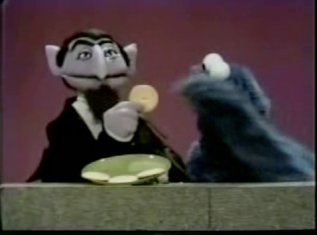
So, here's the discussion question: Which kind of muppet is The Count?

Sure, at first glance he seems clearly in the order camp (he, by his own admission, loves to count, a clear sign of orderliness).

But there are two arguments for his inclusion in the Chaos camp.

Indulging his Order tendencies
against the Ur-Chaos-Muppet
First, the Count is scary. Of course, there are plenty of things that are both orderly and scary (the DMV comes to mind, as does the Galactic Empire). The Count's scariness (at least in earlier, less sanitized versions of Sesame Street) is in spite of his order-qualities, not because of it. The thunder, the caped entrance, the music; all of these things distract from counting.

On its own, this would seem to argue for the Count's inclusion in the order camp. After all, counting is his identity. Scariness is ancillary.

But watch the video below, and tell me that it is not the portrait of someone in the chaos camp. Particularly at 2:10 onward, the Count outs himself as a Chaos Muppet: "I wrote these letters myself... Oh, I'm not going to read them. I'm going to count them!... Ahahahaha!"

His need to count overwhelms any sense of orderliness about the very act of counting. The Count is crazy about counting! Thus, by overindulging his order-quality, the Count transforms himself into a Chaos muppet.

To discuss:
Which other muppets blur the line?
Are you an Order Muppet or a Chaos Muppet? Which particular muppet are you?