Tuesday, October 30, 2012

Argo: A Cosmic Conflagration

Last night, Heather and I went to see "Argo" (Affleck, 2012). In light of having recently seen "Sneakers," I kept thinking of "Argo" as a heist movie. The con man is a CIA agent, working for the forces of law and order; the mark is the Iranian revolutionary movement; the goods are six American diplomats; the oddball heist crew consists of Hollywood insiders and a few CIA agents.

Set in 1980, at the height of the Iranian/American hostage crisis, the film focuses on six diplomats who escaped the hostage-taking. Their safety is compromised, and the American government wants to bring them back. The con involves Agent Tony Mendez (Ben Affleck, who directed, plays Mendez), pitching a harebrained scheme to his superiors: He, and the six, will masquerade as members of a film crew who have been location scouting in Tehran.


"Argo" is based on a true story, and it includes within the fictionalization real audio and video from the events portrayed (Carter's voice, news footage imposed onto TVs throughout the film, etc.). But the film does a good job of bracketing fact from fiction. The first moments comprise a brief documentary on the history of U.S.-Iran relations. We fade out to "Based on a True Story," followed by the title. At the end, as the credits roll, we see images from the film matched with the real photographs that were re-created within the fiction.

Situating itself between two very clear presentations of factual information affords "Argo" a level of verisimilitude that would otherwise be lost, without confusing the viewer into believing that the events portrayed happened exactly as they were portrayed. The fiction is heightened by the fact.

The real-life poster for the fake movie.
Not that it needs much heightening; the film is incredibly well-paced, switching from the cooped-up tension of the hidden diplomats to the high-level negotiations between Mendez and his bosses, to the shocking violence on the streets in Tehran. And there is comedy.

John Goodman and Alan Arkin co-star as a makeup artist and producer, respectively, charged with conning the Hollywood press into making a big enough deal about the movie that it provides believable cover for the diplomats. These two play like a pair of character actors in an old studio-system film, lightening the tension just enough to let us catch our breath. Their scenes--buying the script, the costumed read-through, complete with Chewbacca and 3-CPO knock-offs--had me laughing out loud.

The whole movie, in fact, plays like old-time Hollywood: The dashing-but-damaged leading man, the humorous sidekicks, the simplistic villains, the rah-rah ending. We do see some nuance politically: The factual opening sequence reminds viewers of the many missteps of the U.S. government's interactions with Iran. Additionally, while there are no sympathetic characters within the ranks of the revolutionaries, neither are they portrayed as purely malicious (those portrayals go to the more militant Revolutionary Guard). A scene where a young Iranian student reads a statement for the news cameras is movingly intercut with news reporting of a Texas riot where Americans savagely beat an Iranian-American man. Such images evoke the response of Americans to 9/11, while the embassy plot is similar (unintentionally, of course, since the movie was only recently released) to the recent attacks on the U.S. embassy in Benghazi.

In short, "Argo" is tonally timely while remaining formally timeless, and totally worth watching.

Saturday, October 27, 2012

TNT and Cupping: Coffee Lingo Explained


The logo of the sponsoring group: A stylized latte design.
This week was bookended by coffee. The first event was the TNT: no, not the explosive. TNT is shorthand for Thursday Night Throwdown. Not all throwdowns are on Thursday nights, but most of them get called TNT anyway.

This throwdown was on a Thursday. And what, you might ask, is a throwdown?

It's a latte art contest. Baristas, using only the milk pitcher, pour hot foamed milk into espresso in such a way that it leaves a contrasting, white-on-brown design on the top of the cup. These designs can be as simple as a heart or as complex as three hearts nested within a squiggly fern. Two baristas create art at once, set their cups on the judging table, and the judges pick the best one. Everyone pays to play, and the winner takes home the pot.

I didn't win (I didn't even make it out of round 1), but I did get to hang out with some of the most interesting and welcoming people in Chicago's coffee world. We ate pumpkin cupcakes and sipped locally-brewed beer and talked while we watched the other competitors throw down.

So when Heather and I, along with our friend Ashleigh, attended a coffee cupping party this past Thursday, we saw familiar faces.

Cupping is like wine tasting, but for coffee. Unlike a TNT, you don't need to know how to work an espresso machine; you just need a functioning sense of taste and smell. Normally, a public cupping features 3-5 coffees. Participants smell the grounds, taste the coffees, and talk about what makes them similar and different.

At this event, there were more than 30 coffees on the table, all from top-notch roasters the world over, and all sourced from Kenya. This was a once-in-a-lifetime opportunity to taste some of the best and most interesting coffees out there. It was also very loud.

The smelling portion of a cupping is fairly sedate: all the coffees are in 6-8oz. glasses. Participants pick up a glass, shake it, and smell the escaping gasses. The only sounds are the clink of the glasses going back to the table and the occasional "Mmmm" or "Hmmm?" as people react.

But once the hot water is poured into the glasses, participants can't pick them up (they're hot!). So everyone has a soup spoon, which they dip into the cup, fill with coffee, and slurp. The slurping is loud, short, and explosive. The coffee should be vaporized, hitting all the taste buds in the mouth at the same time. A polite sip from the soup spoon will not leave a correct impression (as Ashleigh learned: "When I slurp, they taste better," she said).

Imagine, then, a coffee shop, crowded with people. The room smells of coffee, and on every open surface are glasses filled with grounds and hot water and small bags with notes like "Stumptown Portland: Nyeri AA Kenya. Crisp grapefruit and honeydew in a full body." Concrete floors and open ceilings reverberate with a low chatter, but mostly with SLLLURRRRP, HISSSSST, and the clink of spoons on rinse cups.

As we left, walking down the hallway, the sound of slurping followed us.

Monday, October 8, 2012

Sneakers

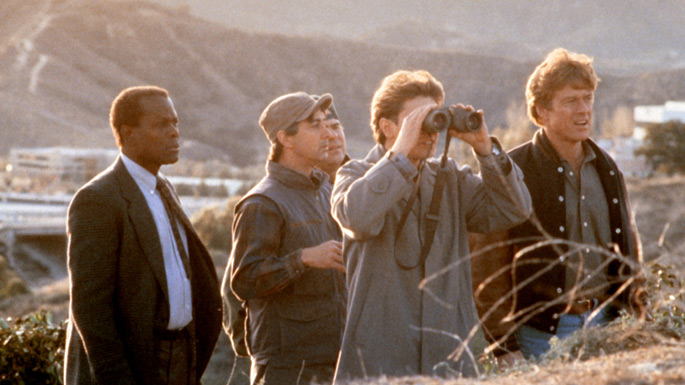
Awhile back, I mentioned that I might write about Sneakers (Robinson, 1992). Slate wrote extensively about this movie a few months ago, so I tracked it down at the public library.

It's a lighthearted but complicated heist movie. Those of you who know me know that I have a weak spot for heist movies, particularly funny ones, so it's not surprising that I thoroughly enjoyed this movie.

While it's not over-the-top hilarious, the comic performances are what make this one stand out. Robert Redford, Sidney Poitier, David Strathairn, Dan Aykroyd, River Phoenix, and Ben Kingsley all feature to some degree, and they all (with the exception of Kingsley's attempt at an American accent) do a great job of making us laugh, and at making us believe the story.

Which, by the way, centers on a group of misfits, led by Redford's Mart Bishop. They break into banks (slight spoiler to the opening scene coming up, but don't worry about it) at the request of the banks, as a live-test of the banks' own security. They're all criminals to some extent, and nerds to a greater extent.

Already, the concept is reflexive: the con men conning for the good guys, the break-in helping prevent break-ins. It is about fooling the system, and the system includes surveillance cameras. The sneakers themselves use video and audio for their own ends as well (extensive film-student ramblings re: the cinema eye pointing back at the viewer, etc. cut for length). Yet for all its self-consciousness, Sneakers never slips into self-parody.

When you watch it, think of the scene just after the scrabble scene: the characters gather around the computer. In the cutting to and from the computer screen, we are reminded that these characters, funny, pratfall-prone, and pedestrian as they can be, have a high reverence for knowing things. Of course (as must be the case) they end up knowing too much.

Nonetheless, for a movie set and shot in the 1990s, it communicates a surprisingly earnest and prescient concern for the power of (digital) information without beating us over the head with it (an exception to that last clause: Cosmo's (Kingley) speech at the top of the ladder).

A funny, thought-provoking, and suspenseful movie with an A-list cast. What more could you ask for?

You could ask for a stronger female lead, especially from a movie that wears its progressive politics so proudly. You could ask Ben Kingsley to re-dub his dialogue with a British accent, since plot holes are easier to overlook than poor delivery. You could ask Robert Redford to find Paul Newman and bring some of that Sundance Kid charm. But really, you can't have everything.


Monday, September 24, 2012

Off the Rails

In every process -- or maybe just in many processes -- there is that moment where it all can, to use a train metaphor, go off the rails. One moment, everything is fine -- under control, exactly as it should be, utterly predictable -- and then, in an instant that is sometimes imperceptible and sometimes notable for its incredible clarity, everything is out of control, exactly as it should not be, and predictable only in its calamity.

Today, that instant was crystalline: standing the basement kitchen, making a note in my notebook, and smoke pours out of the coffee roaster. Roasting is generally smoky, but the smoke that is now filling the kitchen is unprecedented. For a moment, pen still in hand, I pause. It is beautiful, gray-black smoke, and some of it is filtering in boring straight lines into the exhaust fan. The majority of it swirls hypnotically into the kitchen. It smells pungent, like dry woodsmoke mixed with chocolate and some sort of essential oil that an old hippie might burn to cover up the scent of pot. The coffee roaster is still on the stove. The coffee is still in the roaster. It is popping, like that dry wood fire. The cell structure of the coffee beans is audibly breaking down. Soon, I know (from research, not experience) the flaked-off coffee matter and the oil that is pouring through the compromised cell walls will combust, probably very dramatically. The coffee, the stove, the roaster, the thermometer that I have jerry-rigged into the roaster, the notebook, and the man who was moments ago noting how well the process was proceeding will all be consumed in the fireball. It may even travel up the exhaust fan and billow out into the side alley. The fire trucks will definitely appear, perhaps in time to save the house.

Sometimes (though never in my experience playing with H-O scale model trains as a child) the train goes back on the rails.

I pull the roaster from the heat, coughing in the smoke. I pour it into the cooling tray atop a fan, forcing  cool air through the bed of beans. I set the roaster to the side, waving the smoke towards the exhaust fan. Both the roaster and the beans are still smoking, and for a moment, I fear that the beans are going to ignite the cooling fan, and that the resultant electrical fire will be unstoppable. But the smoke dies, and as it does, I station myself beside the smoke detector, waving the clouds away, fooling it with artificial wind. "What a fresh, autumnal breeze," it thinks in its robot brain, "everything is under control in this house. No danger of fire."


Tuesday, September 18, 2012

Conspiracy Theory

Someone always leaves the New York Times on the big shared table in the coffeeshop. We get the Times here at the house, so I never bother to take it home. Usually, I fold it and put it on the window ledge and go back to the espresso machine. Usually, on the front page of the business section, I find a strange legend. First, to the left of the header, four capital letters. Today's: "MGYR." Then, to the right, inevitably circled, "sell," followed by four more letters. Today's: "MNAT."

A little bit of digging reveals that MNAT is the stock symbol for Marquette National Corporation, a Chicago area bank, and that MGYR is Magyar Bankcorp, a New Jersey bank. So some sort of financial investor, that makes sense, especially in a well-to-do neighborhood like East Hyde Park. But why is the left hand symbol always unaccompanied by "sell," and why is the right hand symbol always "sell" and never "buy?"

Maybe something else is going on here. Maybe the problem is too small of a sample size. More newspapers might reveal the answers, especially if I tack them onto a corkboard and connect overlapping symbols with red twine. Maybe I'll just notice who leaves the paper, and then ask her/him what the deal is. Maybe s/he is a secret agent, so I'll keep a mug of hot coffee on hand, just in case I need a defense/distraction. I'll pump my tires tonight, so that my bike will be ready for a fast getaway. I'll leave this record here. If you don't hear from me, remember MGYR / sell MNAT.

---

This departure from reality was inspired in part by the heist comedy Sneakers (Robinson, 1992). Check it out. I'll try to have a review posted soon. The newspapers are totally real, by the way.

Monday, September 10, 2012

Music on the Northside


For the second time since I moved to Chicago, I found myself in Rogers Park. Before you get to the self-contained, self-absorbed suburb of Evanston, Rogers Park is the farthest north that Chicago will allow. 

I left the red line stop at Granville, and walked north to the next stop, Loyola, crossing from Edgewater to Rogers Park one block before I got to the station. Then I turned west on Devon. The last time I was this far north, it was by accident: CTA construction forced Heather and I to travel north to Loyola in order to switch to a southbound train. All southbound track from whichever northern neighborhood we were then visiting was closed for repairs, repairs that will soon creep south and, by the spring, completely shut down the red line in our part of town. 

Joy Ike
This time, it was intentional. Joy Ike, a singer-songwriter from PA was touring through, and we both had chances to enjoy her music when we lived in Harrisburg. Here's why we were so far north: there are two Uncommon Grounds. One of them is in the not-nearly-as-far-north Lakeview. We didn't really look that hard at Google Maps before committing to go, and inviting friends, and talking up the show, and then realizing where it really was. 

We made it, and we got some food and drink, and the first of the three acts (Joy Ike being the second) began. He was terrible. I know that you can use the magic of the internet to figure out his name if you want to, but I won't provide it here. His banter was politically incorrect ("Shout out to my friend's bachelor party here tonight. We got some sexually charged men in the house. All you other men, hold onto your ladies." and later "I sound like a retarded Neil Young. Makes me want to commit suicide") and his lyrics were reminiscent of a B-list Billy Joel. That he covered "Movin' Up" did nothing to dispel this illusion. That he used the wrong key harmonica in his closing song was unsurprising.

Angela Sheik
The only good thing about terrible opening acts is that they only make the headliners look good by comparison, and that was exactly what happened here. Joy Ike and Angela Sheik are touring the Midwest together, and everything that their opener did wrong, they did right: Engaging, unconventional music, mixed with genuine, sensitive banter, and a stage presence that was neither apologetic nor arrogant (their opener had, somehow, managed both). 

Ike's set was great. If you haven't listened to her music yet, just go ahead and put some on while you read. She has a great sense of rhythm, and she's willing to vary time signatures without straying too far from an accessible pop sound, while her lyrics deal with real topics that can stray quite far from the canon of accessible pop songs.

Maybe it was the novelty of seeing someone new (I've seen Joy play once before), but Angela Sheik was the evening's highlight. Angela Sheik is a looping artist, so 1) I was predisposed to find her music a bit gimmicky, but 2) her music packs  a huge punch live, more so than it does in any video or audio recording. Looping involves using a digital recorder to record a bit of sound and replay it repeatedly, usually to create an ambient drone or a rhythmic backing line.

In this case, Sheik performed her riffs live, cued them into the machine, and then cued them on and off with a foot pedal, letting each bit of sound build up behind her as she performed with the next instrument, then turning the loops on and off to create texture. We saw each bit performed live, and then heard it return again and again. Sheik is an accomplished singer, and her set exemplified a vocal range that extends in pitch and dynamics.

Though she sometimes performs with a theremin, at this gig, she used only an autoharp and a flute, tapping on the microphone to create percussion (and maybe, if I heard right, using one or two pre-recorded drum samples), and of course, singing in harmony with herself via the magic of the loop. She opened with some original songs, included an all-vocal loop performance of Amazing Grace, and closed her set with a cover of Radiohead's "Fifteen Step." While it was no live drumline, Sheik's cover sealed a great set that opened my eyes to the creative potential of looping.

The same construction that had forced us so far north the first time delayed our return trip, and we didn't get home to Hyde Park until close to 2AM. Even though I was waking up at 5:30 for work the next day, it was worth the trip.

Saturday, September 1, 2012

Urban Kayaking

The Chicago River links the Great Lakes with the Mississippi. The Great Lakes are linked, via the Saint Lawrence Seaway, with the Atlantic. The Mississippi flows into the Gulf of Mexico. So one can circumnavigate the eastern U.S. via Chicago.

We put our kayaks in at a little dock on the Chicago River Turning Basin, a square, dredged out lake where large barges can turn. The river isn't a very active commercial waterway (we never see any large cargo vessels, either on kayaks or as we wander downtown), but it has the potential.

The river is an active tourism space. There are at least three kayak rental facilities along its banks, and we encountered seven different tour boats (some of them more than once) plying their way through the city.

The turning basin is north of the city center. The two branches of the river surrounding Goose Island reconvene in the basin, and the river flows north from there as the North Branch. South, the way we paddled, one encounters residential, industrial, and commercial districts before the confluence at Wolf Point. We, as the smallest traffic on the water, were advised to give way at all times (though, as non-powered vessels, traditional maritime traffic rules gave us right-of-way). The confluence was the most dangerous point, a T intersection with no stop signs.

We passed through the confluence with no other traffic, paddling well ahead of the couple in the tandem boat that had left the rental dock at the same time. Our adventure occurred further down the river's main branch, just past the downtown private yacht garage and amidst the riverside cafes and bars. We paddled east, towards Lake Michigan, passing under streets and near landmarks that we see whenever we go downtown.

At Clark Street, we decided to turn back. We waited for two tour boats to go by, and then nodded at each other. We faced our boats into the channel, across the wake of a pleasure boat, and paddled hard. A bright yellow water taxi bearing down the channel. Using our paddles like whitewater kayakers, we dug into the waves that crashed over the bows of our kayaks, pulling towards the far seawall, safe from the main channel. From the bridge above us, we heard "Yeahhhh! Kayaks! Woooo! Kayakers!"

Heather raised her paddle in salute, and then we sliced in again, letting the wake from the water taxi rock us back and forth, a welcome respite from the flat water on the north branch.