Last Saturday, we had a Haymarket House Christmas party, complete
with secret Santa gifts and carol-singing around the tree. One of
our housemates suggested that we compose our own "Twelve Days of
Christmas." There were twelve of us, so we went around, composing verses
as we sang. What we came up with sheds some light on co-op living:
Day 1: A blender that doesn't break down
Since
there are thirteen of us living in this house, and most of us like
smoothies, blenders get heavy use, and break fairly often. Our current
blender has a five-year warranty, and looks pretty industrial. We're hoping it lasts a year.
Day 2: Two legal egresses
Our
house was recently (right before Heather and I moved in) renovated to
comply with city code, much of which has to do with fire safety and
escape routes.
Day 3: Three empty cook days
Again,
there are thirteen of us. Since we each cook twice per month, this
means that some days, there is no one scheduled to cook dinner.
Day 4: Four elemental bathrooms
There
are four bathrooms in the house, each one named for an Aristotelian element (there is also a mysterious fifth "Heart Bathroom")
Day 5: Five-week-old seitan
Seitan
is a wheat-based meat substitute. It is easiest to make in large
batches, when it can then be used for meals. This bulk process means
that sometimes the seitan gets real old.
Day 6: Six make-up chores
When
a co-op member doesn't get their chore done on time, they have to do a
make-up chore in addition to the chore that they neglected. No one ever
racks up six at once, as far as I know.
Day 7: Seven awkward silences
With
so many people around the dinner table, conversations inevitably split
apart and recombine in interesting patterns, sometimes resulting in
everyone in silence at the same time.
Day 8: Eight alarms alarming
With
the renovations, a state-of-the-art fire alarm system was installed.
What that means is that, if one alarm is triggered, the whole floor,
then the whole building is triggered with blaring alarms. Sometimes,
even when the situation is under control, the system continues to sound.
Eight is not a stretch.
Day 9: Nine bakers baking
Lots
of people in the house like to bake. All stereotypes of co-ops to the
contrary, "bake" is not a euphemism for marijuana use in this lyric. It
actually refers to cookies, cakes, etc.
Day 10: Ten kinds of beans
Pinto, Garbanzo, Black, Red, White, Green, Kidney, Navy, Coffee, and the dog named Bean who used to live here. Beans are important when you aren't eating meat.
Day 11: Eleven socialists protesting
We live in a house named for one of the most famous workers'-rights happenings in U.S. history. And one of our housemates is a community organizer.
Day 12: Twelves rooms named for spices
Each bedroom is, in fact, named for a different cooking spice. Heather and I live in Crushed Red Pepper.
Sunday, December 16, 2012


Saturday, December 8, 2012
Last night, we were walking through the park near our house. I had my bike with me, rolling at my side. One of our neighbors was walking towards us with his dog. The dog leaned back and barked at us, neither threatening nor welcoming us. We looked at each other. The neighbor looked at us, guiding his dog off of the sidewalk to let us pass. "He's afraid of bicycles," he said.
Thursday, November 22, 2012
Too much coffee?
I had a dream that my hand grinder got water inside it, which was terrible, because in my dream it had high-carbon steel burrs, and they rust almost immediately when they get wet. So I was really mad, but when I took it apart, it had porcelain burrs, so it was all right.
Then, later in the dream, I was at a coffee shop where they only served Sumatran coffees, and I had decided that I didn't like Sumatran coffees, and I didn't know what to do.
Then, later in the dream, I was at a coffee shop where they only served Sumatran coffees, and I had decided that I didn't like Sumatran coffees, and I didn't know what to do.
Monday, November 19, 2012
Barista Competition?
This weekend, I learned what it means to be a competing barista.
Friday, I attended a great cupping at Counter Culture's Chicago office. I also planned to take my barista certification exam. The practical exam is structured like a barista competition routine: a high-pressure, low-time presentation that falls somewhere between a stage performance and a busy moment at a cafe. Even though the time is more than adequate for the certification version, I was not prepared for it. I passed my written exam, but I froze up during the practical exam, and, instead of making single cappuccinos (as the rules dictate) I made doubles, among some other glaring errors. So I'll have to re-cert, which was incredibly disappointing, as I was hoping to go home a certified barista.
Thankfully, the next day, I got a great consolation prize: I attended a workshop on barista competition (and so, by extension, barista certification) with the current US barista champion, Katie Carguilo. She performed her award-winning routine (this video is from the World Barista Championship, where she competed with different coffees than at the USBC) live, as we learned what competition judges are looking for.
It was great to spend nearly a whole weekend at Counter Culture's Chicago training center, to hang out, work, and chat with folks who know and care so much about something that I also know and care about.
Even as I poke around into other career paths here in Chicago, it's nice to move towards certification as a signpost on my coffee journey. And who knows? Regional competition is in January, so maybe I'll enter.
P.S. While the video linked above gives a good sense of the competition scene in general, this interview highlights the actual coffees that Katie presented during the workshop that I attended.
Friday, I attended a great cupping at Counter Culture's Chicago office. I also planned to take my barista certification exam. The practical exam is structured like a barista competition routine: a high-pressure, low-time presentation that falls somewhere between a stage performance and a busy moment at a cafe. Even though the time is more than adequate for the certification version, I was not prepared for it. I passed my written exam, but I froze up during the practical exam, and, instead of making single cappuccinos (as the rules dictate) I made doubles, among some other glaring errors. So I'll have to re-cert, which was incredibly disappointing, as I was hoping to go home a certified barista.
Thankfully, the next day, I got a great consolation prize: I attended a workshop on barista competition (and so, by extension, barista certification) with the current US barista champion, Katie Carguilo. She performed her award-winning routine (this video is from the World Barista Championship, where she competed with different coffees than at the USBC) live, as we learned what competition judges are looking for.
It was great to spend nearly a whole weekend at Counter Culture's Chicago training center, to hang out, work, and chat with folks who know and care so much about something that I also know and care about.
Even as I poke around into other career paths here in Chicago, it's nice to move towards certification as a signpost on my coffee journey. And who knows? Regional competition is in January, so maybe I'll enter.
P.S. While the video linked above gives a good sense of the competition scene in general, this interview highlights the actual coffees that Katie presented during the workshop that I attended.
Tuesday, October 30, 2012
Argo: A Cosmic Conflagration
Last night, Heather and I went to see "Argo" (Affleck, 2012). In light of having recently seen "Sneakers," I kept thinking of "Argo" as a heist movie. The con man is a CIA agent, working for the forces of law and order; the mark is the Iranian revolutionary movement; the goods are six American diplomats; the oddball heist crew consists of Hollywood insiders and a few CIA agents.
Set in 1980, at the height of the Iranian/American hostage crisis, the film focuses on six diplomats who escaped the hostage-taking. Their safety is compromised, and the American government wants to bring them back. The con involves Agent Tony Mendez (Ben Affleck, who directed, plays Mendez), pitching a harebrained scheme to his superiors: He, and the six, will masquerade as members of a film crew who have been location scouting in Tehran.
"Argo" is based on a true story, and it includes within the fictionalization real audio and video from the events portrayed (Carter's voice, news footage imposed onto TVs throughout the film, etc.). But the film does a good job of bracketing fact from fiction. The first moments comprise a brief documentary on the history of U.S.-Iran relations. We fade out to "Based on a True Story," followed by the title. At the end, as the credits roll, we see images from the film matched with the real photographs that were re-created within the fiction.
Situating itself between two very clear presentations of factual information affords "Argo" a level of verisimilitude that would otherwise be lost, without confusing the viewer into believing that the events portrayed happened exactly as they were portrayed. The fiction is heightened by the fact.
Not that it needs much heightening; the film is incredibly well-paced, switching from the cooped-up tension of the hidden diplomats to the high-level negotiations between Mendez and his bosses, to the shocking violence on the streets in Tehran. And there is comedy.
John Goodman and Alan Arkin co-star as a makeup artist and producer, respectively, charged with conning the Hollywood press into making a big enough deal about the movie that it provides believable cover for the diplomats. These two play like a pair of character actors in an old studio-system film, lightening the tension just enough to let us catch our breath. Their scenes--buying the script, the costumed read-through, complete with Chewbacca and 3-CPO knock-offs--had me laughing out loud.
The whole movie, in fact, plays like old-time Hollywood: The dashing-but-damaged leading man, the humorous sidekicks, the simplistic villains, the rah-rah ending. We do see some nuance politically: The factual opening sequence reminds viewers of the many missteps of the U.S. government's interactions with Iran. Additionally, while there are no sympathetic characters within the ranks of the revolutionaries, neither are they portrayed as purely malicious (those portrayals go to the more militant Revolutionary Guard). A scene where a young Iranian student reads a statement for the news cameras is movingly intercut with news reporting of a Texas riot where Americans savagely beat an Iranian-American man. Such images evoke the response of Americans to 9/11, while the embassy plot is similar (unintentionally, of course, since the movie was only recently released) to the recent attacks on the U.S. embassy in Benghazi.
In short, "Argo" is tonally timely while remaining formally timeless, and totally worth watching.
Set in 1980, at the height of the Iranian/American hostage crisis, the film focuses on six diplomats who escaped the hostage-taking. Their safety is compromised, and the American government wants to bring them back. The con involves Agent Tony Mendez (Ben Affleck, who directed, plays Mendez), pitching a harebrained scheme to his superiors: He, and the six, will masquerade as members of a film crew who have been location scouting in Tehran.
"Argo" is based on a true story, and it includes within the fictionalization real audio and video from the events portrayed (Carter's voice, news footage imposed onto TVs throughout the film, etc.). But the film does a good job of bracketing fact from fiction. The first moments comprise a brief documentary on the history of U.S.-Iran relations. We fade out to "Based on a True Story," followed by the title. At the end, as the credits roll, we see images from the film matched with the real photographs that were re-created within the fiction.
Situating itself between two very clear presentations of factual information affords "Argo" a level of verisimilitude that would otherwise be lost, without confusing the viewer into believing that the events portrayed happened exactly as they were portrayed. The fiction is heightened by the fact.
 |
| The real-life poster for the fake movie. |
John Goodman and Alan Arkin co-star as a makeup artist and producer, respectively, charged with conning the Hollywood press into making a big enough deal about the movie that it provides believable cover for the diplomats. These two play like a pair of character actors in an old studio-system film, lightening the tension just enough to let us catch our breath. Their scenes--buying the script, the costumed read-through, complete with Chewbacca and 3-CPO knock-offs--had me laughing out loud.
The whole movie, in fact, plays like old-time Hollywood: The dashing-but-damaged leading man, the humorous sidekicks, the simplistic villains, the rah-rah ending. We do see some nuance politically: The factual opening sequence reminds viewers of the many missteps of the U.S. government's interactions with Iran. Additionally, while there are no sympathetic characters within the ranks of the revolutionaries, neither are they portrayed as purely malicious (those portrayals go to the more militant Revolutionary Guard). A scene where a young Iranian student reads a statement for the news cameras is movingly intercut with news reporting of a Texas riot where Americans savagely beat an Iranian-American man. Such images evoke the response of Americans to 9/11, while the embassy plot is similar (unintentionally, of course, since the movie was only recently released) to the recent attacks on the U.S. embassy in Benghazi.
In short, "Argo" is tonally timely while remaining formally timeless, and totally worth watching.
Saturday, October 27, 2012
TNT and Cupping: Coffee Lingo Explained
 | |
| The logo of the sponsoring group: A stylized latte design. |
This throwdown was on a Thursday. And what, you might ask, is a throwdown?
It's a latte art contest. Baristas, using only the milk pitcher, pour hot foamed milk into espresso in such a way that it leaves a contrasting, white-on-brown design on the top of the cup. These designs can be as simple as a heart or as complex as three hearts nested within a squiggly fern. Two baristas create art at once, set their cups on the judging table, and the judges pick the best one. Everyone pays to play, and the winner takes home the pot.
I didn't win (I didn't even make it out of round 1), but I did get to hang out with some of the most interesting and welcoming people in Chicago's coffee world. We ate pumpkin cupcakes and sipped locally-brewed beer and talked while we watched the other competitors throw down.
So when Heather and I, along with our friend Ashleigh, attended a coffee cupping party this past Thursday, we saw familiar faces.
Cupping is like wine tasting, but for coffee. Unlike a TNT, you don't need to know how to work an espresso machine; you just need a functioning sense of taste and smell. Normally, a public cupping features 3-5 coffees. Participants smell the grounds, taste the coffees, and talk about what makes them similar and different.
At this event, there were more than 30 coffees on the table, all from top-notch roasters the world over, and all sourced from Kenya. This was a once-in-a-lifetime opportunity to taste some of the best and most interesting coffees out there. It was also very loud.
 The smelling portion of a cupping is fairly sedate: all the coffees are in 6-8oz. glasses. Participants pick up a glass, shake it, and smell the escaping gasses. The only sounds are the clink of the glasses going back to the table and the occasional "Mmmm" or "Hmmm?" as people react.
But once the hot water is poured into the glasses, participants can't pick them up (they're hot!). So everyone has a soup spoon, which they dip into the cup, fill with coffee, and slurp. The slurping is loud, short, and explosive. The coffee should be vaporized, hitting all the taste buds in the mouth at the same time. A polite sip from the soup spoon will not leave a correct impression (as Ashleigh learned: "When I slurp, they taste better," she said).
Imagine, then, a coffee shop, crowded with people. The room smells of coffee, and on every open surface are glasses filled with grounds and hot water and small bags with notes like "Stumptown Portland: Nyeri AA Kenya. Crisp grapefruit and honeydew in a full body." Concrete floors and open ceilings reverberate with a low chatter, but mostly with SLLLURRRRP, HISSSSST, and the clink of spoons on rinse cups.
As we left, walking down the hallway, the sound of slurping followed us.
Monday, October 8, 2012
Sneakers
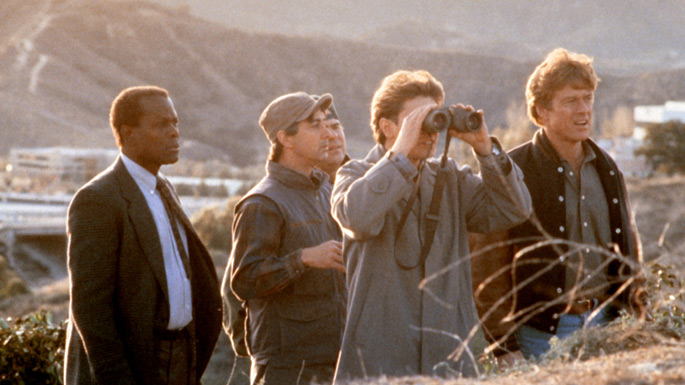
It's a lighthearted but complicated heist movie. Those of you who know me know that I have a weak spot for heist movies, particularly funny ones, so it's not surprising that I thoroughly enjoyed this movie.
While it's not over-the-top hilarious, the comic performances are what make this one stand out. Robert Redford, Sidney Poitier, David Strathairn, Dan Aykroyd, River Phoenix, and Ben Kingsley all feature to some degree, and they all (with the exception of Kingsley's attempt at an American accent) do a great job of making us laugh, and at making us believe the story.
Which, by the way, centers on a group of misfits, led by Redford's Mart Bishop. They break into banks (slight spoiler to the opening scene coming up, but don't worry about it) at the request of the banks, as a live-test of the banks' own security. They're all criminals to some extent, and nerds to a greater extent.
Already, the concept is reflexive: the con men conning for the good guys, the break-in helping prevent break-ins. It is about fooling the system, and the system includes surveillance cameras. The sneakers themselves use video and audio for their own ends as well (extensive film-student ramblings re: the cinema eye pointing back at the viewer, etc. cut for length). Yet for all its self-consciousness, Sneakers never slips into self-parody.
When you watch it, think of the scene just after the scrabble scene: the characters gather around the computer. In the cutting to and from the computer screen, we are reminded that these characters, funny, pratfall-prone, and pedestrian as they can be, have a high reverence for knowing things. Of course (as must be the case) they end up knowing too much.
Nonetheless, for a movie set and shot in the 1990s, it communicates a surprisingly earnest and prescient concern for the power of (digital) information without beating us over the head with it (an exception to that last clause: Cosmo's (Kingley) speech at the top of the ladder).
A funny, thought-provoking, and suspenseful movie with an A-list cast. What more could you ask for?
You could ask for a stronger female lead, especially from a movie that wears its progressive politics so proudly. You could ask Ben Kingsley to re-dub his dialogue with a British accent, since plot holes are easier to overlook than poor delivery. You could ask Robert Redford to find Paul Newman and bring some of that Sundance Kid charm. But really, you can't have everything.
Subscribe to:
Posts (Atom)