Wednesday, April 17, 2013

Good Bye Blogger

In an effort to simplify my life, I'm moving my blogging endeavors to my photo blog at moretracks.tumblr.com

Look for new posts there.

Saturday, March 9, 2013

Nathan and Will visited, and so should YOU

Nathan and Will just left after a week's worth of visiting. I'm using their visit as an excuse to compile a list of awesome Chicago things to do. This is for you, friends-who-have-yet-to-vist-Chicago!

Come see us, and you'll have the chance to...

- Eat deep-dish pizza three times, from three different restaurants ("or my name's not Nathan Van Patter!"): Giordano's, the Medici, Lou Malnati's.

- Stroll on Broadway, buy a hat in the wrong size, and have it re-sized by the excellent folks at Goorin Brothers Hats.

- Hike to and from a free acoustic blues luncheon at Buddy Guy's Legends (in the biggest blizzard in years, if you're as lucky as Nathan and Will were).

- Be overwhelmed by the size of the Art Institute of Chicago ("We spent so much time there, and we didn't even see the famous Seurat!")

- Taste the Chicago Mix (caramel popcorn and cheddar popcorn), not from tourists' favorite Garrett, but from Southside gem MotherButter's.

- Cobble together a donut tasting in the city's new artisanal donut mecca, River North, featuring FireCakes, Fritz Pastries (visiting the neighborhood for a pop-up shop), and (almost, if they hadn't sold out for the day!) Donut Vault.

- Get coffee at Intelligentsia, Bow Truss, and Bridgeport Coffee Company.

- Share a Pork & Cider meat pie at Pleasant House.

- Watch a 95-year-old bridge across the Chicago River undergo a total reconstruction (all right, you can only really do that if you visit in the next three weeks).

- See the seething arctic ice at the edge of Promontory Point (if this doesn't sound fun, visit in the summer and replace "see the seething arctic ice" with "swim").

- Play the Haunted House game A LOT (I am always up for this, btw).

- Join Haymarket House for whatever happens to be going on (ironing a book? tasting 12-year single-malt scotch? building shelves? playing TWO games of Dominion simultaneously?).

- Learn to navigate the CTA and the Chicago street grid.

- Contradance at University of Chicago (or decline to do so, due to fatigue from so much walking around).

- Be surprised by whatever new exhibit is at the Chicago Cultural Center.

- Pick up Indian takeout from Rajun Cajun and Chicago-style hot dogs from Hyde Park Gyros.

- Find the Lincoln Park Conservatory's small dinosaurs (they're really in there!).

- Visit the Lincoln Park Zoo (at closing time to see the animals doing their thing).

Monday, February 18, 2013

Come and show me another city with lifted head singing...

I'm experimenting with tumblr, where I put my photos. I've posted this post on this blog, and on that one.

*    *    *

I don’t know how it took me this long to finally read this cornerstone of Chicago literature, but here it is:
CHICAGO
by Carl Sandburg

Hog Butcher for the World,
   Tool Maker, Stacker of Wheat,
   Player with Railroads and the Nation’s Freight Handler;
   Stormy, husky, brawling,
   City of the Big Shoulders:

They tell me you are wicked and I believe them, for I have seen your painted women under the gas lamps luring the farm boys.
And they tell me you are crooked and I answer: Yes, it is true I have seen the gunman kill and go free to kill again.
And they tell me you are brutal and my reply is: On the faces of women and children I have seen the marks of wanton hunger.
And having answered so I turn once more to those who sneer at this my city, and I give them back the sneer and say to them:
Come and show me another city with lifted head singing so proud to be alive and coarse and strong and cunning.
Flinging magnetic curses amid the toil of piling job on job, here is a tall bold slugger set vivid against the little soft cities;
Fierce as a dog with tongue lapping for action, cunning as a savage pitted against the wilderness,
   Bareheaded,
   Shoveling,
   Wrecking,
   Planning,
   Building, breaking, rebuilding,
Under the smoke, dust all over his mouth, laughing with white teeth,
Under the terrible burden of destiny laughing as a young man laughs,
Laughing even as an ignorant fighter laughs who has never lost a battle,
Bragging and laughing that under his wrist is the pulse, and under his ribs the heart of the people,
                   Laughing!
Laughing the stormy, husky, brawling laughter of Youth, half-naked, sweating, proud to be Hog Butcher, Tool Maker, Stacker of Wheat, Player with Railroads and Freight Handler to the Nation.

Thursday, February 7, 2013

Games

I've been doing game stuff with the folks at Waxwing for a while now, but I'm particularly proud of this, a write-up that Waxwing's founder Andy and I did for a game that I wrote and executed early this year.

Wednesday, February 6, 2013

Monday, January 28, 2013

Lake Michigan: Cerulean

On the east side of Harold Washington Park, on the east side of Hyde Park, is a bridge across Lake Shore Drive. On the other side is the lake shore. Looking south, the view is Promontory Point, Hyde Park's favorite lakeshore hangout. The shoreline curves east into the lake, to the end of the point, where stands an old lighthouse.

Today, crossing the bridge over the highway and looking out, I noticed that the lake was an unusual color. At first, I thought it was the fog discoloring things. Downtown, usually a clear view north, was obscured in fog. But after I crossed the bridge and walked down to the shore, I saw the real reason: ice.

The whole shoreline, as far as I could see -- the rocky breakwaters, the cement promenades, the end of the point -- was encased in ice. Last night's ice storm, coupled with today's 50+ degree weather, had turned the shore of Lake Michigan into a dead ringer for the Antarctic coast.

From the stunning cerulean water to the miniature icebergs that were calving into the lake, to the sheen on the whitened, icy rocks, everything was there, a testament to what? A usual Chicago winter? The unpredictability of global climate change? I'm new here, so I couldn't tell, but it was beautiful, and of course, I didn't have my camera.

Thursday, January 24, 2013

Francis Bacon

Francis Bacon is dead. I'm using his real name here. In at least one earlier post on this blog, I gave him a pseudonym, out of respect. Now, I'd like to use his real name, also out of respect.

Of course, Francis Bacon may not be his real name. It's just too good of a name to be true, but that's how we knew him in the bookstore.

The man himself was not too good to be true. He was a panhandler, a drunk, a rabble-rouser, and a purveyor of sexist opinions. More than once, I had to ask him to leave the bookstore where I worked. He would show up in the balcony and start hitting on the singers or heckling the politicians who frequented the store. Then I would sigh, walk upstairs, and ask him to leave.

I know what is said about speaking ill of the dead, but I need to make it clear that I'm not romanticizing the man.

When I last saw Francis Bacon, a few months before he died, he was starting in on Paradise Lost. He would never heckle the authors who came to give book talks, did I mention that? His heckling, especially when he was drunk, took in all and sundry, including the owner of the store, the mayor of Harrisburg, and even yours truly.

"Is that how you coil cables here?" he would say to me, as I packed up the microphones from an event, "at the theater I managed, you would've been fired on the first day."

But Francis had respect for the arts, so he never heckled even the most pitiful self-published self-help author, and that's why he was reading Paradise Lost. Of course, he didn't have his own copy. Instead, he would enter the store with his huge backpacker's bag, walk into the "famous authors" section, and grab Paradise Lost. He would go to his chair, set down the pack, and open the book.

He never bought a book, and he never stole a book, but he read through all of Don Quixote and most of Paradise Lost in the time that I knew him.

He marked his place in the book and put it right back on the shelf in alphabetical order in the "famous authors" section, even when he was being thrown out for disorderly conduct and heckling. He always came back to apologize after such an event.

All of this is to say that Francis Bacon led, as far as I can tell, a wild, open life. By no means perfect, but I'm glad to have known him and I'm sorry that he's gone. I hope he finished Paradise Lost.

Monday, January 21, 2013

Caravanserai

Though it seems contrarian, we both ordered beer when we went to the City Winery last night. Despite the name, the primary attraction at the City Winery is not wine. It's musicians, usually folk-rock or singer-songwriter types.

Last night, however, the City Winery sprouted a dance floor, welcomed a drumming troupe, a Balkan band, and a Middle-Eastern-surf-rock band for a "warm gathering," as one of the bandleaders said.

"We need to devote all of the abandoned places in the city to gatherings like this one," he said, and he was right. People of diverse ethnicities, national origins, languages, clapping styles (on the 1 and the 3, the 2 and the 4, or on the 1, the 'and' of 2, and the 4), and dancing styles came together along long tables for food and wine (or in our case, beer), getting up to dance as the mood struck.

The troupe of drummers punctuated the acts, the surf-rock group (featuring an oud, a clarinet, a tricked-out Middle-Eastern drum set, an electric bass, and an electric guitar run through some classic reverb pedals) played for a traditional dancer, but Chicago's own Black Bear Combo got us all out on the dance floor.

We also got out on the dance floor because we saw one of our co-op friends, and one of our housemates. They practice yoga and capoiera respectively, so we weren't incredibly surprised to see them dancing. We... well, people have learned that Heather and I don't have a square, run-of-the-mill social life, so they weren't really surprised to see us either.

We didn't stay too late, but we did join the dancing circle as the band stepped off the stage and, in traditional balkan-band fashion, stood in the middle of all of us, playing as we danced and clapped along.

Friday, January 18, 2013

Check this out: http://www.npr.org/blogs/allsongs/2013/01/16/169541318/an-illustrator-drawn-to-live-music

Saturday, January 5, 2013

More Coffee Stuff

Photo Courtesy of the New York Times.
The New York Times just did a great piece on what it takes to become a barista. The short version: It's harder than it looks, and yes, you can taste the difference.

Sunday, December 30, 2012

Life of Pi: The Movie

There were definitely some things that I liked about Ang Lee's recent adaptation of Yann Martel's Booker-Prize-winning novel, but they were overwhelmed by the movie's over-reliance on computer-generated images.

The early scenes of Pi's childhood in Pondicherry were the most coherent. The schoolroom scenes in particular set the magical-realist tone that allows both the book and the movie to do what it is that they do, and the scenes of Pi's religious education glowed with color and life.

That said, once at sea, the movie falls victim to an unfortunate technological quandary: The CGI isn't good enough. The animals in the zoo are believable; seeing animals in a cage allows us to overcome our disbelief. At sea, however, out of their narrative element, the zoo animals fall apart. The zebra sliding around with rubbery legs might match the book's description, and might even look like a real zebra sliding on a ship's deck. But actual verisimilitude is not CGI's central issue. We need to be allowed to suspend our disbelief. Showing unbelievable images (zebra on a ship's deck, tiger in a lifeboat, etc.) places CGI in jeopardy, and Life of Pi's CGI is not up the challenge.

The tiger's face is believable enough, but as soon as the camera pulls back, the overly-lifelike fur and the too-lithe legs betray the image. I am not trying to pick nits here; were this problem limited to a few scenes, it would not sink the movie. Since this movie relies upon the believability of the unbelievable image, since most of its running time involves the CGI tiger, it cannot succeed.

Interestingly enough, this throws the movie into the same role as Pi's narrative within the film: We, like the Yann Martel character in the apartment scenes, cannot believe the story we are being told. Had this been the filmmakers' intent, this movie would have been unbelievably interesting. Sadly, that movie is not what I saw in the theater. 


Sunday, December 16, 2012

Twelve Days of Co-op Christmas

Last Saturday, we had a Haymarket House Christmas party, complete with secret Santa gifts and carol-singing around the tree. One of our housemates suggested that we compose our own "Twelve Days of Christmas." There were twelve of us, so we went around, composing verses as we sang. What we came up with sheds some light on co-op living:

Day 1: A blender that doesn't break down 

Since there are thirteen of us living in this house, and most of us like smoothies, blenders get heavy use, and break fairly often. Our current blender has a five-year warranty, and looks pretty industrial. We're hoping it lasts a year.

Day 2: Two legal egresses

Our house was recently (right before Heather and I moved in) renovated to comply with city code, much of which has to do with fire safety and escape routes.

Day 3: Three empty cook days

 Again, there are thirteen of us. Since we each cook twice per month, this means that some days, there is no one scheduled to cook dinner.

Day 4: Four elemental bathrooms

There are four bathrooms in the house, each one named for an Aristotelian element (there is also a mysterious fifth "Heart Bathroom")

Day 5: Five-week-old seitan

Seitan is a wheat-based meat substitute. It is easiest to make in large batches, when it can then be used for meals. This bulk process means that sometimes the seitan gets real old.

Day 6: Six make-up chores

When a co-op member doesn't get their chore done on time, they have to do a make-up chore in addition to the chore that they neglected. No one ever racks up six at once, as far as I know.

Day 7: Seven awkward silences

With so many people around the dinner table, conversations inevitably split apart and recombine in interesting patterns, sometimes resulting in everyone in silence at the same time.

Day 8: Eight alarms alarming

With the renovations, a state-of-the-art fire alarm system was installed. What that means is that, if one alarm is triggered, the whole floor, then the whole building is triggered with blaring alarms. Sometimes, even when the situation is under control, the system continues to sound. Eight is not a stretch.

Day 9: Nine bakers baking

Lots of people in the house like to bake. All stereotypes of co-ops to the contrary, "bake" is not a euphemism for marijuana use in this lyric. It actually refers to cookies, cakes, etc.

Day 10: Ten kinds of beans

Pinto, Garbanzo, Black, Red, White, Green, Kidney, Navy, Coffee, and the dog named Bean who used to live here. Beans are important when you aren't eating meat.

Day 11: Eleven socialists protesting

We live in a house named for one of the most famous workers'-rights happenings in U.S. history. And one of our housemates is a community organizer.

Day 12: Twelves rooms named for spices

Each bedroom is, in fact, named for a different cooking spice. Heather and I live in Crushed Red Pepper.

Saturday, December 8, 2012

Last night, we were walking through the park near our house. I had my bike with me, rolling at my side. One of our neighbors was walking towards us with his dog. The dog leaned back and barked at us, neither threatening nor welcoming us. We looked at each other. The neighbor looked at us, guiding his dog off of the sidewalk to let us pass. "He's afraid of bicycles," he said.

Thursday, November 22, 2012

Too much coffee?

I had a dream that my hand grinder got water inside it, which was terrible, because in my dream it had high-carbon steel burrs, and they rust almost immediately when they get wet. So I was really mad, but when I took it apart, it had porcelain burrs, so it was all right.

Then, later in the dream, I was at a coffee shop where they only served Sumatran coffees, and I had decided that I didn't like Sumatran coffees, and I didn't know what to do.

Monday, November 19, 2012

Barista Competition?

This weekend, I learned what it means to be a competing barista.

Friday, I attended a great cupping at Counter Culture's Chicago office. I also planned to take my barista certification exam. The practical exam is structured like a barista competition routine: a high-pressure, low-time presentation that falls somewhere between a stage performance and a busy moment at a cafe. Even though the time is more than adequate for the certification version, I was not prepared for it. I passed my written exam, but I froze up during the practical exam, and, instead of making single cappuccinos (as the rules dictate) I made doubles, among some other glaring errors. So I'll have to re-cert, which was incredibly disappointing, as I was hoping to go home a certified barista.

Thankfully, the next day, I got a great consolation prize: I attended a workshop on barista competition (and so, by extension, barista certification) with the current US barista champion, Katie Carguilo. She performed her award-winning routine (this video is from the World Barista Championship, where she competed with different coffees than at the USBC) live, as we learned what competition judges are looking for.

It was great to spend nearly a whole weekend at Counter Culture's Chicago training center, to hang out, work, and chat with folks who know and care so much about something that I also know and care about.

Even as I poke around into other career paths here in Chicago, it's nice to move towards certification as a signpost on my coffee journey. And who knows? Regional competition is in January, so maybe I'll enter.

P.S. While the video linked above gives a good sense of the competition scene in general, this interview highlights the actual coffees that Katie presented during the workshop that I attended.


Tuesday, October 30, 2012

Argo: A Cosmic Conflagration

Last night, Heather and I went to see "Argo" (Affleck, 2012). In light of having recently seen "Sneakers," I kept thinking of "Argo" as a heist movie. The con man is a CIA agent, working for the forces of law and order; the mark is the Iranian revolutionary movement; the goods are six American diplomats; the oddball heist crew consists of Hollywood insiders and a few CIA agents.

Set in 1980, at the height of the Iranian/American hostage crisis, the film focuses on six diplomats who escaped the hostage-taking. Their safety is compromised, and the American government wants to bring them back. The con involves Agent Tony Mendez (Ben Affleck, who directed, plays Mendez), pitching a harebrained scheme to his superiors: He, and the six, will masquerade as members of a film crew who have been location scouting in Tehran.


"Argo" is based on a true story, and it includes within the fictionalization real audio and video from the events portrayed (Carter's voice, news footage imposed onto TVs throughout the film, etc.). But the film does a good job of bracketing fact from fiction. The first moments comprise a brief documentary on the history of U.S.-Iran relations. We fade out to "Based on a True Story," followed by the title. At the end, as the credits roll, we see images from the film matched with the real photographs that were re-created within the fiction.

Situating itself between two very clear presentations of factual information affords "Argo" a level of verisimilitude that would otherwise be lost, without confusing the viewer into believing that the events portrayed happened exactly as they were portrayed. The fiction is heightened by the fact.

The real-life poster for the fake movie.
Not that it needs much heightening; the film is incredibly well-paced, switching from the cooped-up tension of the hidden diplomats to the high-level negotiations between Mendez and his bosses, to the shocking violence on the streets in Tehran. And there is comedy.

John Goodman and Alan Arkin co-star as a makeup artist and producer, respectively, charged with conning the Hollywood press into making a big enough deal about the movie that it provides believable cover for the diplomats. These two play like a pair of character actors in an old studio-system film, lightening the tension just enough to let us catch our breath. Their scenes--buying the script, the costumed read-through, complete with Chewbacca and 3-CPO knock-offs--had me laughing out loud.

The whole movie, in fact, plays like old-time Hollywood: The dashing-but-damaged leading man, the humorous sidekicks, the simplistic villains, the rah-rah ending. We do see some nuance politically: The factual opening sequence reminds viewers of the many missteps of the U.S. government's interactions with Iran. Additionally, while there are no sympathetic characters within the ranks of the revolutionaries, neither are they portrayed as purely malicious (those portrayals go to the more militant Revolutionary Guard). A scene where a young Iranian student reads a statement for the news cameras is movingly intercut with news reporting of a Texas riot where Americans savagely beat an Iranian-American man. Such images evoke the response of Americans to 9/11, while the embassy plot is similar (unintentionally, of course, since the movie was only recently released) to the recent attacks on the U.S. embassy in Benghazi.

In short, "Argo" is tonally timely while remaining formally timeless, and totally worth watching.

Saturday, October 27, 2012

TNT and Cupping: Coffee Lingo Explained


The logo of the sponsoring group: A stylized latte design.
This week was bookended by coffee. The first event was the TNT: no, not the explosive. TNT is shorthand for Thursday Night Throwdown. Not all throwdowns are on Thursday nights, but most of them get called TNT anyway.

This throwdown was on a Thursday. And what, you might ask, is a throwdown?

It's a latte art contest. Baristas, using only the milk pitcher, pour hot foamed milk into espresso in such a way that it leaves a contrasting, white-on-brown design on the top of the cup. These designs can be as simple as a heart or as complex as three hearts nested within a squiggly fern. Two baristas create art at once, set their cups on the judging table, and the judges pick the best one. Everyone pays to play, and the winner takes home the pot.

I didn't win (I didn't even make it out of round 1), but I did get to hang out with some of the most interesting and welcoming people in Chicago's coffee world. We ate pumpkin cupcakes and sipped locally-brewed beer and talked while we watched the other competitors throw down.

So when Heather and I, along with our friend Ashleigh, attended a coffee cupping party this past Thursday, we saw familiar faces.

Cupping is like wine tasting, but for coffee. Unlike a TNT, you don't need to know how to work an espresso machine; you just need a functioning sense of taste and smell. Normally, a public cupping features 3-5 coffees. Participants smell the grounds, taste the coffees, and talk about what makes them similar and different.

At this event, there were more than 30 coffees on the table, all from top-notch roasters the world over, and all sourced from Kenya. This was a once-in-a-lifetime opportunity to taste some of the best and most interesting coffees out there. It was also very loud.

The smelling portion of a cupping is fairly sedate: all the coffees are in 6-8oz. glasses. Participants pick up a glass, shake it, and smell the escaping gasses. The only sounds are the clink of the glasses going back to the table and the occasional "Mmmm" or "Hmmm?" as people react.
But once the hot water is poured into the glasses, participants can't pick them up (they're hot!). So everyone has a soup spoon, which they dip into the cup, fill with coffee, and slurp. The slurping is loud, short, and explosive. The coffee should be vaporized, hitting all the taste buds in the mouth at the same time. A polite sip from the soup spoon will not leave a correct impression (as Ashleigh learned: "When I slurp, they taste better," she said).

Imagine, then, a coffee shop, crowded with people. The room smells of coffee, and on every open surface are glasses filled with grounds and hot water and small bags with notes like "Stumptown Portland: Nyeri AA Kenya. Crisp grapefruit and honeydew in a full body." Concrete floors and open ceilings reverberate with a low chatter, but mostly with SLLLURRRRP, HISSSSST, and the clink of spoons on rinse cups.

As we left, walking down the hallway, the sound of slurping followed us.

Monday, October 8, 2012

Sneakers

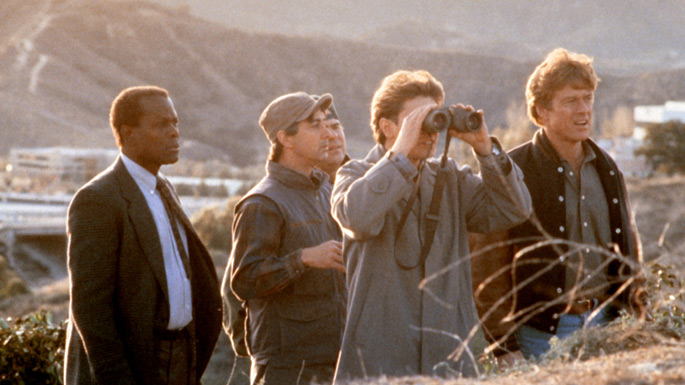
Awhile back, I mentioned that I might write about Sneakers (Robinson, 1992). Slate wrote extensively about this movie a few months ago, so I tracked it down at the public library.

It's a lighthearted but complicated heist movie. Those of you who know me know that I have a weak spot for heist movies, particularly funny ones, so it's not surprising that I thoroughly enjoyed this movie.

While it's not over-the-top hilarious, the comic performances are what make this one stand out. Robert Redford, Sidney Poitier, David Strathairn, Dan Aykroyd, River Phoenix, and Ben Kingsley all feature to some degree, and they all (with the exception of Kingsley's attempt at an American accent) do a great job of making us laugh, and at making us believe the story.

Which, by the way, centers on a group of misfits, led by Redford's Mart Bishop. They break into banks (slight spoiler to the opening scene coming up, but don't worry about it) at the request of the banks, as a live-test of the banks' own security. They're all criminals to some extent, and nerds to a greater extent.

Already, the concept is reflexive: the con men conning for the good guys, the break-in helping prevent break-ins. It is about fooling the system, and the system includes surveillance cameras. The sneakers themselves use video and audio for their own ends as well (extensive film-student ramblings re: the cinema eye pointing back at the viewer, etc. cut for length). Yet for all its self-consciousness, Sneakers never slips into self-parody.

When you watch it, think of the scene just after the scrabble scene: the characters gather around the computer. In the cutting to and from the computer screen, we are reminded that these characters, funny, pratfall-prone, and pedestrian as they can be, have a high reverence for knowing things. Of course (as must be the case) they end up knowing too much.

Nonetheless, for a movie set and shot in the 1990s, it communicates a surprisingly earnest and prescient concern for the power of (digital) information without beating us over the head with it (an exception to that last clause: Cosmo's (Kingley) speech at the top of the ladder).

A funny, thought-provoking, and suspenseful movie with an A-list cast. What more could you ask for?

You could ask for a stronger female lead, especially from a movie that wears its progressive politics so proudly. You could ask Ben Kingsley to re-dub his dialogue with a British accent, since plot holes are easier to overlook than poor delivery. You could ask Robert Redford to find Paul Newman and bring some of that Sundance Kid charm. But really, you can't have everything.


Monday, September 24, 2012

Off the Rails

In every process -- or maybe just in many processes -- there is that moment where it all can, to use a train metaphor, go off the rails. One moment, everything is fine -- under control, exactly as it should be, utterly predictable -- and then, in an instant that is sometimes imperceptible and sometimes notable for its incredible clarity, everything is out of control, exactly as it should not be, and predictable only in its calamity.

Today, that instant was crystalline: standing the basement kitchen, making a note in my notebook, and smoke pours out of the coffee roaster. Roasting is generally smoky, but the smoke that is now filling the kitchen is unprecedented. For a moment, pen still in hand, I pause. It is beautiful, gray-black smoke, and some of it is filtering in boring straight lines into the exhaust fan. The majority of it swirls hypnotically into the kitchen. It smells pungent, like dry woodsmoke mixed with chocolate and some sort of essential oil that an old hippie might burn to cover up the scent of pot. The coffee roaster is still on the stove. The coffee is still in the roaster. It is popping, like that dry wood fire. The cell structure of the coffee beans is audibly breaking down. Soon, I know (from research, not experience) the flaked-off coffee matter and the oil that is pouring through the compromised cell walls will combust, probably very dramatically. The coffee, the stove, the roaster, the thermometer that I have jerry-rigged into the roaster, the notebook, and the man who was moments ago noting how well the process was proceeding will all be consumed in the fireball. It may even travel up the exhaust fan and billow out into the side alley. The fire trucks will definitely appear, perhaps in time to save the house.

Sometimes (though never in my experience playing with H-O scale model trains as a child) the train goes back on the rails.

I pull the roaster from the heat, coughing in the smoke. I pour it into the cooling tray atop a fan, forcing  cool air through the bed of beans. I set the roaster to the side, waving the smoke towards the exhaust fan. Both the roaster and the beans are still smoking, and for a moment, I fear that the beans are going to ignite the cooling fan, and that the resultant electrical fire will be unstoppable. But the smoke dies, and as it does, I station myself beside the smoke detector, waving the clouds away, fooling it with artificial wind. "What a fresh, autumnal breeze," it thinks in its robot brain, "everything is under control in this house. No danger of fire."


Tuesday, September 18, 2012

Conspiracy Theory

Someone always leaves the New York Times on the big shared table in the coffeeshop. We get the Times here at the house, so I never bother to take it home. Usually, I fold it and put it on the window ledge and go back to the espresso machine. Usually, on the front page of the business section, I find a strange legend. First, to the left of the header, four capital letters. Today's: "MGYR." Then, to the right, inevitably circled, "sell," followed by four more letters. Today's: "MNAT."

A little bit of digging reveals that MNAT is the stock symbol for Marquette National Corporation, a Chicago area bank, and that MGYR is Magyar Bankcorp, a New Jersey bank. So some sort of financial investor, that makes sense, especially in a well-to-do neighborhood like East Hyde Park. But why is the left hand symbol always unaccompanied by "sell," and why is the right hand symbol always "sell" and never "buy?"

Maybe something else is going on here. Maybe the problem is too small of a sample size. More newspapers might reveal the answers, especially if I tack them onto a corkboard and connect overlapping symbols with red twine. Maybe I'll just notice who leaves the paper, and then ask her/him what the deal is. Maybe s/he is a secret agent, so I'll keep a mug of hot coffee on hand, just in case I need a defense/distraction. I'll pump my tires tonight, so that my bike will be ready for a fast getaway. I'll leave this record here. If you don't hear from me, remember MGYR / sell MNAT.

---

This departure from reality was inspired in part by the heist comedy Sneakers (Robinson, 1992). Check it out. I'll try to have a review posted soon. The newspapers are totally real, by the way.